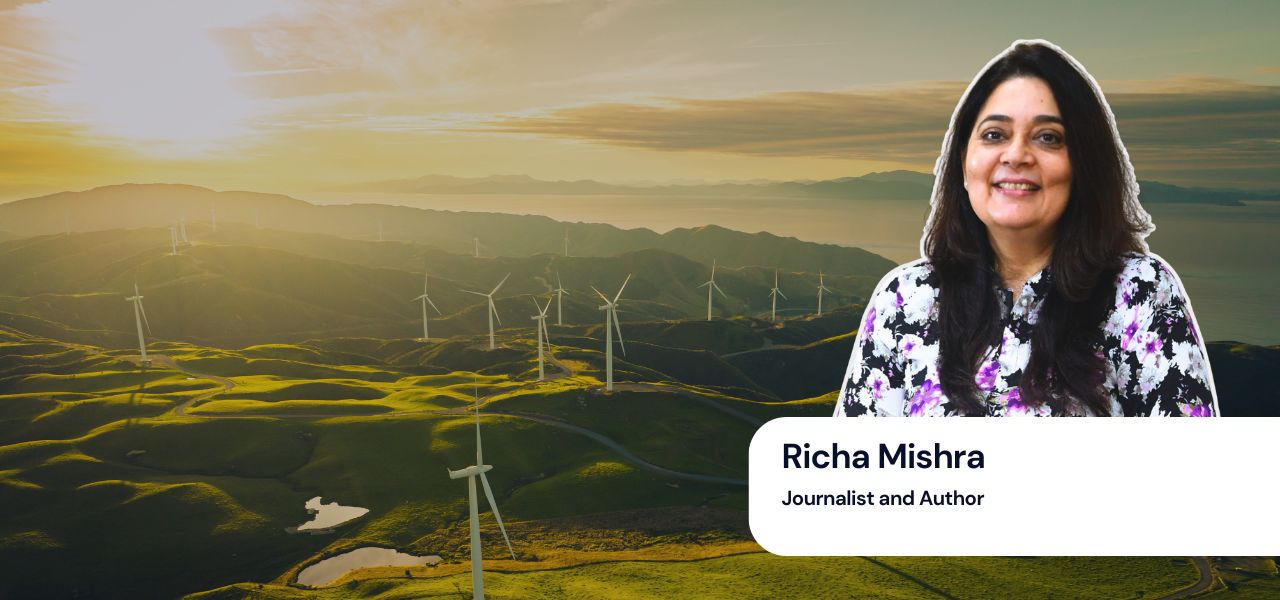

India’s energy economy has started 2026 on both a chaotic and a promising note. Last year’s storms of trade wars and the disarray of the country’s energy supply chain have spilled into this year as well. But 2025 was also the year India crossed the threshold of 50 per cent non-fossil fuel power generation capacity and took promising steps in nuclear energy. This year has commenced with policy shifts in the long languishing power distribution sector and trade deals with focus on sustainable development.
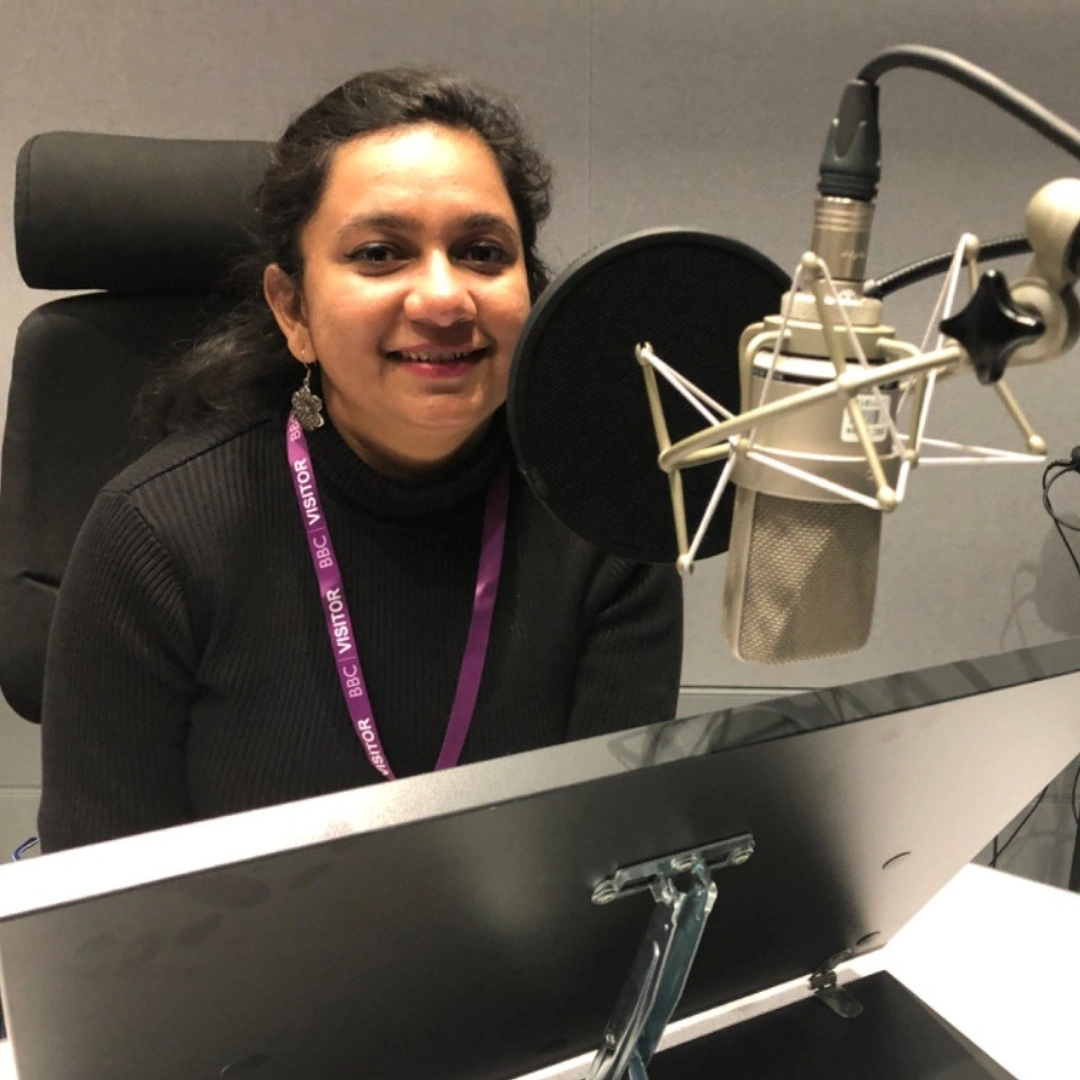
To guide through this maze of varied developments which would impact India’s energy transition and security, we spoke with Richa Mishra, seasoned energy journalist and author. Ms Mishra has been writing on the energy sector for more than two decades and has first-hand witnessed the evolution of India’s energy sector and has covered notable milestones in her journalistic journey.
She is currently Resident Editor at Hindu Business Line. Ms Mishra also runs a podcast called Energonomics where she unpacks the developments of the oil and gas sector. Her first book Unfilled Barrels: India’s oil story published in 2022 offers a ringside view of India’s oil and gas sector from past to present
Author page of Richa Mishra: https://www.thehindubusinessline.com/profile/author/richa-mishra-10928/
Energonomics podcast by Richa Mishra: https://youtube.com/playlist?list=PL0y1IAo9tjT5TiZmuziacoYWd8rjX6dde&si=SzrnSAEKYRy7n2dF
Unfilled Barrels: India’s Oil story: https://www.bloomsbury.com/in/unfilled-barrels-9789354350283/
Listen to the episode with full transcript here in English
[Podcast intro]
Welcome to Season 6 of the India Energy Hour podcast. This podcast explores the most pressing hurdles and promising opportunities of India’s energy transition through an in-depth discussion on policies, financial markets, social movements, and science. Your hosts for this episode are Shreya Jay, Delhi-based energy and climate journalist, and Dr. Sandeep Pai, energy transition researcher and author. The show is produced by 101 Reporters, a pan-India network of grassroots reporters that produces original stories from rural India. If you like our podcast, please rate us on Spotify, Apple Podcasts, or the platform where you listen to our podcast. Your support will help us reach a larger audience.
India’s energy economy has started 2026 on both a chaotic and a promising note. Last year’s storms of trade wars and the disarray of the country’s energy supply chain have spilled into this year as well. But 2025 was also the year India crossed the threshold of 50 per cent non-fossil fuel power generation capacity and took promising steps in nuclear energy. This year has commenced with policy shifts in the long languishing power distribution sector and trade deals with focus on sustainable development.
To guide through this maze of varied developments which would impact India’s energy transition and security, we spoke with Richa Mishra, seasoned energy journalist and author. Ms Mishra has been writing on the energy sector for more than two decades and has first-hand witnessed the evolution of India’s energy sector and has covered notable milestones in her journalistic journey.
She is currently Resident Editor at Hindu Business Line. Ms Mishra also runs a podcast called Energonomics where she unpacks the developments of the oil and gas sector. Her first book Unfilled Barrels: India’s oil story published in 2022 offers a ringside view of India’s oil and gas sector from past to present
[Podcast interview]
Shreya Jai: Hello, everyone. Welcome to the brand-new Season 6 of the India Energy Hour. It’s a new season loaded with new episodes, new guests, new topics and everything new that you can think of. We’ll be exploring new areas, new venues, new topics, some very research-oriented, some controversial. We’ll see how this year goes by. But to kickstart this year and this season, we have a very special guest who has been tracking this sector for close to three decades now. And no one could have given us a better start this year than her. Welcome to the India Energy Hour, ma’am. Very grateful and very happy to have you here.
Richa Mishra: It’s my pleasure. And thank you, all of you, for having me over to kick off the season, as you just said.
Shreya Jai: As I just mentioned, you have been a journalist for three decades now and more than 20 years. You have written on the energy sector, all aspects of it, you know, and in your several roles as a reporter, as a editor, as a bureau chief. You have seen, you know, what this sector has gone through, not just energy, but allied sectors of infrastructure, etc. as well. So let me just begin with asking you, what has been your journey like in journalism? You know, how it started? What led to energy reporting? Can you tell us about that?
Richa Mishra: So, yeah, journeys in journalism started because of one man, you know, and you grew up reading him and listening to him. That was none other than Mr. Elba. And the generation, which was my growing up generation, you had names like Mr. Sanjay Baru, Mr. Enram, Arun Shuri, you know, names like these who were there and, you know, the pick of things. So, yeah, they had quite an influence. My journey into this profession started in 1994. And, you know, nothing like to work under the man you have always admired. He was my editor-in-chief. Mr. Enram was my editor-in-chief. And, you know, campus from college to the Hindu office. And the business line was just launched. So you can say I’m as old as business line in the profession. So, yeah, out and out of business line products. But the person who actually shaped me, who actually nurtured me, and my writing and my thinking, everything is very, very influenced by his work, is Mr. K. Venugopal, who was my first editor in business line. And he was my editor for almost 11 years. And, you know, the basic thing he taught us or he told us was that a man on the street should understand what you want to say. You’re not writing for a drawing room audience. It is for everyone. It is for everyone. And everyone should understand. His joke used to be a mommy in my lapur. That is, an auntie in my lapur should also understand what you are writing. So, you know, that influenced my writing quite a bit. And subsequently in my career, I got to work with a man who I call a spin doctor. His writing, he can write everything in 350 words. That was Mr. T. C. Srinivasaragwan. What a beauty. I mean, if someone can romance with the language, it was that man. So, you know, these were certain people who really influenced my writing. And, again, Dr. Sanjay Bara was, again, a very, very big influence on my work and how I worked and what I did. So, you know, he was also quite a strong influence in my working and how I did. In fact, when I was doing my book course, so I went to Dr. Baru and I had to say, you’ll have to write a foreword for me. And he was kind enough to do that. So, your journey into journalism has been very, very interesting. And I’ve been asked fun comments also, Shreya. Like, I’ve spent my lifetime in business life. So, someone has actually asked me, is it because you never got any other offers or is the organization just too good that you have stuck in that organization? But then my job profile has changed. I’m one of the few who has worked into different centers of business life. I’ve worked on desk. I’ve gone into reporting. I’ve headed a team in Delhi. Then I came back to the state and I’m like working here. So, yeah, it’s been a journey.
Sandeep Pai: Great.
Richa Mishra: Yeah. It’s not easy for women to be in this field. Let me also put it that way. Yeah.
Sandeep Pai: Of course. So, just kind of one follow-up question that really comes to my mind is like, you know, it’s 30 years is a long time in the energy space. You know, it has completely transformed the energy sector from just, you know, really heavy fossil fuel energy deprived country to now looking at renewables and looking at all the above, embracing every kind of energy. So, in this period, what has been some of your personal milestone and, you know, what have been some memorable ones? And how has the journalism sector itself evolved, especially the energy reporting with the landscape of changes in the energy sector itself?
Richa Mishra: There’s been a complete change in, not only in the energy space, but overall, in the journalism space. The concept of reporting has really changed, you know, and whether we like it or not, Google uncle and aunties and AIs have actually enhanced armchair reporting more. And the other thing is that anyone who comes into this field, you know, everyone wants to become an editor. No one wants to be a reporter. So, I could be wrong. People may not agree. But my personal experience is that we’re having lesser number of reporters. People may not agree. If you remember, for example, Shreya is reaching out to me, chatting with me. Why? Because I’m still visible. And what makes me visible or my brand is my writing. I’m known because of my writing. Now, that’s something. And only those names, you know, you see people who are on the field. so that’s something which is you know going away and the other thing is you know when we started like I’ll give you an example I was always a finance reporter corporate affairs reporter I was established in that area so when I moved to Delhi I was in business lunch tonight and I moved to Hyderabad and then I moved to Delhi so till then I had not covered energy as a subject as a beat so when I moved to Delhi and there was the person who used to cover earlier had to move out and that’s when I came into this sector I have to tell you this I have a dream of every business journalist is to cover ministry of finance but I would say the person who has covered energy space whether it is power ministry or petroleum ministry or coal or mines it’s actually become a true journal because you have corporates you have finance you have geopolitics you have domestic politics you have everything so you know the canvas is wide and it’s huge so that’s one thing but to your question coming back to your question as to what change I see less of reading you know more of jargons and more of opinions than what exactly is happening.
Shreya Jai: I remember we were texting the other day and we were talking that maybe we’ll have to resort to memes and reels for the new generation to read about this sector you have your own podcast that you run energynomics and I think that is one attempt to capture that new generation as well but you know if I can ask you to just look back again and talk about some of the memorable events and this is my favorite questions to you know journalists who are senior who have seen it all in this sector you you and I’m so happy you said that you know covering energy sector is better than covering a finance ministry or something like that but any milestones that you remember a couple of them which were like if not career altering but you would consider them a milestone something memorable that you covered and it’s still edged in your memory.
Richa Mishra: Yes I can tell you that there were three or four stories which actually established me as an energy reporter there are three four stories and yeah you know the high point if at the cost of sounding a little pompous the high point of any journalist is when the government comes out and justifies that okay and it happened to me immediately within seven months of me starting to cover the energy space if you recollect i mean that time the oil minister was Mr. mani shankaraya and i was very raw and you have covered the energy space so you know how it works it’s kind of a country it works like even the journalists are like so you really can’t crack into it at least people like us it’s not possible to crack in because if you’re always batting with a straight bat you know so the entire team was in Iran and as I mentioned Mr. kvenu gopal who’s my mentor and i am what i am because of that man so and I was raw to the beat he called me one Sunday and said Richard this energy deal with Iran has been signed yes sir the statement is awaited and we’re going to do this too he says no but Iran doesn’t have a liquefaction technology so how are we going to get it now no one is here all the key reporters the minister the government everyone is there and he wanted that story and that’s on a Sunday you know how it is Sunday you’re calling up people you’re raw to the beat so anyway it happened one reached out one got the story and it was a lead in business line the next morning the entire team has come back from Iran and evening we are told there’s a press conference by the minister and the minister is explaining just this point that how we are going to you know yes acknowledging yes they don’t have a technology and how they’re going to get it so you know this this was one of the thing and only after that when your story was acknowledged and the government’s coming out with a statement that you start getting accepted in the field also even your journalist colleagues start accepting you so yeah this was one of the incidents then there were many there were certain stories on gc that happened on reliance that have happened so over the years yes numbers have been taking place.
Sandeep Pai: great, i think this is a great time to dive into the topic so i think you know just starting off with like kind of understanding how 2025 was for the energy sector it was obviously a very tumultuous year in terms of trade and you know different back and forth on climate action and the situation at cop and us pulling out of cop and other climate negotiations etc. so can you just tell us which global issues would continue to impact the Indian energy economy that were there in 2025 but would continue to impact in 2026 as well.
Richa Mishra: the late the biggest one was spoken by dita gopinak that the Indian economy is most impacted by pollution but that aside you know i was just having a conversation with someone and geopolitan politics plays a very important role very important in the entire energy space and if you see i transgress a little that all the big wars have happened on energy or for energy or energy is used as a tool now as recent as the Ukraine war Russia Ukraine conflict which is happening what has happened in the midst of everything is energy you know in one way or the other so geopolitics will continue to play a very important role in this whole thing which is panning now yes there talks about energy transition this talk about you know whether fossil fuel will be there or not whether coal will be there that narrative of course the current American president has changed i mean like he started with drill baby drill and then he said coal is beautiful coal is beautiful India always knew that coal is beautiful that coal is beautiful we have it in abundance but we have our own issues and stories for it so yes you know what would we a thing which will continue and will be very challenging if I’m talking particularly for us India will be how we work out our energy basket there are certain things which we have in abundance so should we focus on them and utilize them and bring down our import bills on fossil fuel a complete strategy has to be worked out and ministries have to sit together and work it out a much difference which i see in the current setup in India is that the narrative of all the ministries is now this way there was a time when what ministry of finance used to say was very different from what the petroleum ministry would say what petroleum ministry is saying the coal ministry had a different narrative what power was saying these two had a different story to tell but now if you see everyone is talking the same now this is a major booster and the biggest thing that happened was that this was the first time where the prime minister of the country i mean in his one of the first conferences an OT conference when he had come i think in the first time yeah in his first stint as Mr. dharmin pradhan was the petroleum minister there he set a target it was the first time the country’s prime minister was setting up a target of how much we could bring down our import dependence that’s a different story that it’s still there when it was but so you know there is this effort this attempt and this acknowledgement which is coming from across all ministries that this is a very important aspect of our economy.
Shreya Jai: thanks for this broad overview you know absolutely points on with that I would like to you know now discuss a little bit minutely about some of the policy shifts that happened in India you know there were a significant policy decisions that the Indian government took last year and some are in motion to happen this year like the new nuclear bill the shanti bill was announced last year and then we were trying to you know realign our whole oil and gas supply chain you know having our different partnership then this year we might see maybe might see the new electricity bill finally seeing the light of the day so you mentioned very rightly that this is the year India needs to really think what its energy basket should look like so first of all these policy decisions that were taken what idea do you think the government is doing is giving in terms of their energy basket and how does it align with our transition goals
Richa Mishra: I’m glad you asked that one thing is clear that we the government of the day understands the importance of this sector that the second point is and that that’s where what I’ve been arguing throughout is we should not shift our goalposts the biggest problem with ourselves you know why do we not talk by a month we never talk we have it we can use it for resources we don’t talk about it we have policies in place we started off with solar you know big bang we did so much we did win our biggest problem is these transitions these policies all are wonderful very good when executed but we always leave them midway and we move on to something new now everyone talking green hydrogen green ammonia do you know where the market is do you know what the price will be like how and what the dynamic will be no we don’t know that so our biggest challenge our biggest problem and this will be the problem for our energy transition process that we keep jumping from one to other take one take it to the logical conclusion then move to second what happened to the gas-based power plants you know there’s no answers we talk we’re talking if Gujarat can become a gas-based economy Gujarat is a very fine example in our country of how you can shift to gas so in Gujarat can become why can’t the other states in the country can become what is stopping us you I’m glad you mentioned the forever in making electricity reforms i don’t know for how many years I have been riding when you rode for quite a number of years now you’re talking about opening of the sector okay you’re going to kill monopoly there true fair enough but then whosoever will have a good pocket will succeed we all know how it will work will you encourage the smaller players to come into the market what happened to i mean let’s do a parallel with what happened to png where are we there pipe natural gas is such a good solution what happened there now lpg cylinders is a very important it is a political thing also it’s very politically sensitive so you can’t do a way a certain section of our society does need lpg cylinders as well so what happens there so our biggest challenge which will remain and i hope in 2026 the government is able to resolve it so all these you know leaving things midway then jumping on to the next whatever the west is doing it’s not necessary that whatever west is doing is good for India no it is not we have wind in a hydro wind sun you know biomass rice why don’t we use them for our generations and electricity power is just one aspect there are others also and the more and bigger challenges that the some of them are state subject now federal structure is so beautiful but then it has its own political challenges as well so it’s always exciting days in this sector.
Sandeep Pai: indeed so just kind of asking a question about the green on the green and on the green energy front what’s next for us I mean we have had aggressive re targets which are pretty much met there’s push towards you know more grid integrated grid systems it’s happening dre had a phase and it’s coming back again what else on the green energy front like are we going to revise our targets make it thousand gigawatts what do you think should be the right way forward on this
Richa Mishra: the toughest thing is to implement what is already there properly and infrastructure create infrastructure whether it is green or fossil fuel storage is something we don’t talk about that is where the focus should be just so we don’t talk about storage facilities so even if we revise the targets even if we go ahead and do things I mean our unless we don’t have the infrastructure in place it won’t help so infrastructure is a key challenge and our focus should be on infrastructure
Shreya Jai: yeah i was just picking on some of the key words that you said federal structure policies and announcements being left midway and you know announcements being made without much thought given to the infrastructure creation so I wanted to ask you in our energy transition story i see this being on repeat you know we started our dre journey and then it was left midway because we were told that there were not much private sector interest same it seems to be happening with green hydrogen as well and there are multiple such examples our electricity mobility journey started with these ambitious targets and now it is just you know companies investing into electric vehicles but not much talk about infrastructure creation my question here is i don’t want to do blame putting but do you think that this is just a federal democratic structure that is to be blamed or you know there is a lacuna in the planning where the center just decides what the policy is thrusts it upon these states and various stakeholders rather it being the other way around something that now several states are clamoring about
Richa Mishra: see it is more to i mean i would say it’s more to do with the federal structure it’s the politics which happens you know why certain things when it is a the same government in the center of the state the implementation process is much easier for example take Telangana for example in Telangana right now the government of the is not the same as what it who it is in the center so this comp health is a challenge revival project is happening you know performance linked the subsidies are coming budgetary grants are coming whatever the way it is working out but the preferences differ the negotiable aspects are different and you know there are certain baggage’s which the governments are carrying the baggage’s are and before we move any further we should not forget that the easiest revenue owner for the governments is energy whether it is whether it is petrol diesel or electricity the tax components the local tax component so high there that it’s easy to you know so neither the states would like to let go of it nor the center would like to it’s easy money you know you’re not doing anything it is Richa and Shreya who are paying it so you know it’s easy revenue which no one wants to let go of
Shreya Jai: do you think because of all these problems this whole energy bill that is being coming up again hopefully would also not reach the success that is being expected this opening up of the sector for the private companies to come in because the same problems are there as you mentioned you know everyone thinks about the politics first and opening up this big power distribution sector for the private companies to come in would lead to i don’t want to use the word but maybe you know protest and writing but we have seen that happening in several states would what would and and also if you can you know have a note of advisory there what can be done different this time that this sector finally comes out of the you know shadows
Richa Mishra: you know Shreya, there’s a very fine example gst, gst is a council where everyone comes on board and the country’s biggest tax reform happened with such smooth scene so why can’t we have a body like a gst council where all states are represented you sort out everything and then go ahead and implement it build a consensus then go ahead and do it our problem is you decide and you have other have to do it no it doesn’t work like that because every state has its own character its own personality its own way of implementing things so why can’t you have something like a gst council in energy space also where you know you take decisions sitting together talking working it out and then implementing it for example we spoke about shantibir right now what have you done there the tariff is centralized who’s going to decide the tariff now that here comes the challenge then i mean end of the day it pinches our pocket who is going to decide the tariff everything boils down to that why is green hydrogen not happening who’s going to decide the pricing why gas did not did not succeed in the power plants because it was tariff the challenge which green energy face solar face thing so we need to have a proper structure you can’t just one someone sitting in new Dali you cannot decide what you can’t decide what Hyderabad will do or what Bengaluru will do you know you have to have a consensus you have to work together and then build on it i mean then only it can happen you cannot play politics over energy but unfortunately that is what happened because that gets you the vote the free gas cylinders move the bidder all that gives you the vote you win elections over it
Sandeep Pai: right so speaking of consensus so thank you for explaining the need for consensus domestically within states and center and all that but talking of consensus with other partners globally so India is the host of bricks this year and themes like inclusive growth sustainable development etc. are floating so what do you think India’s strategy should be to push for energy its energy security energy transition goals as well as manufacturing indigenous manufacturing goals in this kind of you know tumultuous trade time especially as the host of bricks India will have some heat in terms of you know be talking about these issues so we’d love to hear your thoughts on that
Richa Mishra: i wish i could have said wait for my column on Monday then we’ll talk about it but yes i know you you’re very right a number to look at is see the big the members of bricks one of them is among the largest producers of oil one of them has got a super strength in green energy one of them has technology one of them is a consumer you know which countries I’m referring to I mean all it’s like just look at it I mean globally also when these are together I think more than 50 percent of the entire energy ecosystem is taken care of they are so huge among themselves so yes and there is I think they came out with if I’m not wrong some 2025 – 2030 energy agenda I mean what they want to do they’re talking about nuclear also they’re talking about so many things together use of technology sustainability I would say is the most abused world nowadays i mean like everyone and you know anyone uses this word but for the brick nations to come together and if they can join forces then the American president has problem but having said so i i would also like to make one point here that if you notice the other one is for India bilateral work better than multilaterals the kind of bilateral relations India has with different in the current situation if you go back a little in time when Russia was putting us was sorry about that us was putting pressure for Iran for India to stop doing business with Iran we have scummed under pressure we had brought our you know crude sourcing and everything to zero from Iran whereas cut to today when we were under pressure to stop doing business with Russia for oil what was our narrative we are a buyer where will we get cheap we will buy it it’s the same India we’re talking about but as you rightly pointed out today India’s position itself has changed India has come India’s consumption has become its strength today in the energy space because they want to sell and they won’t have such a dedicated market than us to sell their product so you know that has become our strength now India’s Russia relation is at a very different platform Russia China is at a different platform so bilaterally i think with bilateral we were better as bricks together what interesting thing also I mean I don’t know how far it will happen but we are talking about trading in each other’s currency also so that will also work out too well for us in the energy space as i said one of them Brazil can be a good for green energy Russia for fossil China for technology in solar and other space so and of course nuclear we are talking about with oil so I what I would like to see is how the world reacts to the bricks when we keep moving ahead strength to strength I would say.
Shreya Jai: this bilateralism that India is doing in recent years especially it seems to be a shift away from what we were planning say five years back like immediately after covid there was so much push and even before that a little bit over all this make in India and completely dependent on indigenous manufacturing the fate of it the juries are still out on a lot of those schemes including pli but now it seems the language the narrative on how we build our manufacturing is shifting a bit you must have I’m sure observed that we are slightly opening up we are saying it’s okay if you get raw material from a certain country it’s okay if our critical mineral supply chain is built with these three four countries what do you think of this idea this shift that is happening and how fruitful would it be in our whole energy transition journey
Richa Mishra: sure i would say better late than never we should have done this in the beginning itself you know because you cannot work with rigidity in business, i would take you to us what does us do for lng us says buy lng from me okay he tells India buy lng from me when India wants to negotiate on price what does us say it’s a commerce deal the government of the day doesn’t interfere it is the entities the players the corporates who negotiate the price we don’t get involved in pricing that is what we should also be doing we did exactly that for Russian oil you know what we what did we do we said it is for the companies to decide who’s ever is offering them cheap oil they will buy and mind you there was never any sanction on Russian oil there was sanction on Rosneft and bukoil who are the producers of among the top producers of Russian oil there are other players also so now what India refiners are doing they’re buying those can Europe survive if Russia closes the gas tab no you cannot you will have a blackout your economy is also dependent on it so why don’t you bully i mean Putin gave a very good statement you know in that press conference says you are telling India not to buy my oil you’re buying nuclear fuel from me so you know i think is that the Indian government’s positioning should be such that economics should rule not politics as far as energy and space is concerned because we are a very price sensitive market end of the day you and i are paying for it the government cannot see technically we have deregulation in petrol diesel right but we both know that it’s only on paper there are days when there’s no change in price even if the market is changing so for the politics always in energy space the saddest part is politics overruns the business dynamics and there have been long arguments among a lot of people that you know energy policies should be independent of geopolitics this you can do only when you have a mature position and i think India is working towards it which is good to see you know certain things certain decisions which we are taking is moving towards that oh
Shreya Jai: that’s great to know and that’s a very high note to conclude this discussion though i don’t want to I wish we could discuss more go into many specifics but we’ll have you again thank you so much for talking with us to our audience there if you want to read something on India’s oil journey please pick up Richa’s book it’s called unfilled barrels and it’s a very nice story about India’s oil sector as you might as you must have all heard she’s such a nice storyteller so thank you again for joining us here and talking with us it was a very enriching conversation
Richa Mishra: thank you so much and it was pleasure chatting with both of you
Sandeep Pai: thank you Richa from my side as well what a pleasure
Richa Mishra: and have a successful year ahead
Shreya Jai: thank you the start couldn’t have been much better than this so thanks for that
Richa Mishra: Take care, bye bye
[Podcast outro]
Thank you for listening to The India Energy Hour! Subscribe to this channel to never miss an update. To drop us a feedback, visit our website or write to us at [email protected]
We are on Twitter. You can follow @tieh_podcast and get in touch with 2 hosts @shreya_jai and @sandeeppaii
[end]
Listen to the episode with full transcript here in Hindi
Guests

Richa Mishra
GuestJournalist and Author
Hosts