
Energy transition of India, like any other country in the world is currently marred with wars, energy map reset and new challenges of AI and climate financing. Every nation is back on the drawing board to plan their energy future and climate action in a warming, conflicting world.
As The India Energy Hour enters the century club, informed conversations tracking the transition, especially of the Global South led by India become more important than ever.
To get an overview of how far India has come in its transition journey, the lessons that have been learnt along the way and what lies ahead, we hosted a guest who has seen the inside and outside of policymaking and its real-world implementation.
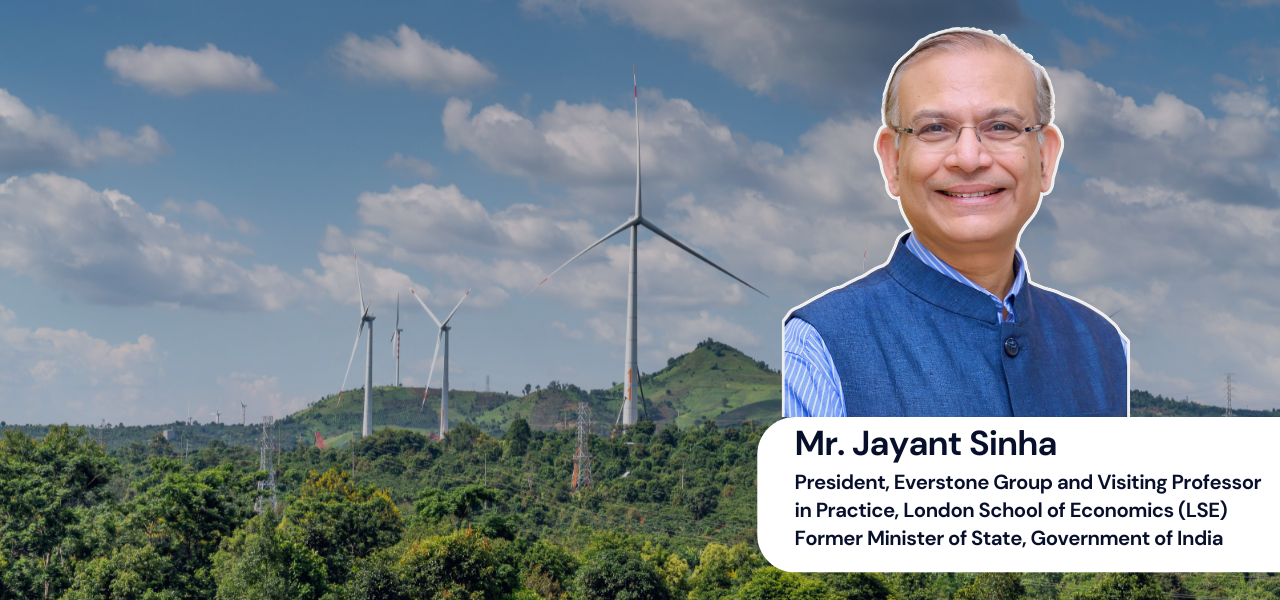
From working in the IT sector to the corridors of the Parliament, from India’s federal ministry of finance to civil aviation and now in the global climate finance universe, Jayant Sinha has donned several hats. He is currently President, Everstone Group and Visiting Professor in Practice, London School of Economics. He is the former minister of state for finance and civil aviation, Government of India (2014 to 2019) and was also chairperson of the Standing Committee on Finance, Parliament of India (2019 to 2024). Sinha is also a prolific writer and his columns on green finance, transition modelling and AI have appeared in leading mainstream publications and research organisations.
Listen to the episode with full transcript here in English
[Podcast intro]
Welcome to The India Energy Hour. This is our 100th episode, an important milestone in our journey over the last five years to bring informed discussions on India’s energy transition and climate action with leading voices of the sector. We hope to continue this expedition further and bring to you episodes which broaden your horizons.
Energy transition of India, like any other country in the world is currently marred with wars, energy map reset and new challenges of AI and climate financing. Every nation is back on the drawing board to plan their energy future and climate action in a warming, conflicting world.
As The India Energy Hour enters the century club, informed conversations tracking the transition, especially of the Global South led by India become more important than ever.
To get an overview of how far India has come in its transition journey, the lessons that have been learnt along the way and what lies ahead, we hosted a guest who has seen the inside and outside of policymaking and its real-world implementation.
From working in the IT sector to the corridors of the Parliament, from India’s federal ministry of finance to civil aviation and now in the global climate finance universe, Jayant Sinha has donned several hats. He is currently President, Everstone Group and Visiting Professor in Practice, London School of Economics. He is the former minister of state for finance and civil aviation, Government of India (2014 to 2019) and was also chairperson of the Standing Committee on Finance, Parliament of India (2019 to 2024). Sinha is also a prolific writer and his columns on green finance, transition modelling and AI have appeared in leading mainstream publications and research organisations.
[Podcast interview]
Shreya Jai: Hello and welcome to the India Energy Hour, Mr. Sina. Thank you so much for joining us here on this very special episode. You have had a fantastic journey and we are looking forward to capture that and along with it, capture the energy transition journey of this country. Thank you again for joining us here today. Thank you very much, Shreya and Sandeep, for having me. Really, really pleased to be with you all on your 100th show. Thank you for that privilege.
Thank you again. I’ll just start this conversation with you, as is our format of this podcast. But unlike some of our other guests, your professional life is very well known, very well publicized. But you have worked in the private sector. Then you went on to become the civil aviation minister. You have also been MOS Finance. While you were a civil aviation minister, you launched the Iran scheme with a very memorable tagline, I must say.
But I want you to talk us through the shifts and the milestones that have shaped your journey. How and why you moved from the IT sector then to public service and now you’re in sustainable finance.
Jayant Sinha: Well, Shreya, this is the question many people ask me, which is why have you stumbled around so much in your life going from one career to another career, from one geography to another geography? What makes sense of all of this? And actually, the truth is that there is a unifying theme in terms of what I have done.
And that unifying theme, and I’ve thought about it a great deal at my advanced stage now, you know, you get a chance to think about these matters. But what I’ve realized that what I have done consistently through my life is really try and use technology for the service of humanity. That’s really what I have been trying to do, is to use technology for the service of humanity. Growing up as a child, I was a science junkie. I’m still a science junkie. I love science. Of course, I’ve been trained as an engineer at IIT Delhi, where I was surrounded by super smart, very scientifically-oriented, technology-oriented people.
And again, you know, the interest that I had in science and technology deepened much further. Then I got a degree in operations research at the University of Pennsylvania. And then after business school, when I joined McKinsey, first in Boston and then much later in India,
Virtually all the work I did, Shreya, was in the technology sector. So I co-authored two of the NASCOM McKinsey reports, for example. I work with some of the world’s leading technology companies during the internet takeoff during the dot-com boom and bust.
So all the work I was doing during this time was technology. And technology, of course, has gone through many different waves and very exciting developments. And as I often used to say, that technology, you know, as far as business is concerned, is extreme business because everything changes in five or 10 years. So you have to rethink your strategy. You have to rethink your organization and so on.
And that, of course, led me eventually to become an investor in the tech sector as well, both as a venture capitalist and as a hedge fund investor. And so I was a technology investor. Of course, when I came into public life, I got an opportunity to go much deeper in another subject, which is finance. And so I’ve done a lot of work in finance as a result of that. I’ve been an investor and so obviously I understood how to use financial instruments. But, you know, if you think about it, finance is technology for money, right? So finance is technology for money. And again, if you can combine finance and technology, you can do all kinds of very interesting things. And that’s what I’m doing right now.
Now, even as I was doing technology in the service of humanity, you have to understand that energy, which is the other big passion I have, is also technology, right? And it’s technology of a different kind. But again, it’s science, right? So, for instance, when we convert carbon into kilojoules, for example, pure energy, you are really applying technology to do that. And of course, I’m a chemical engineer, so I understand how those reactions work.
And of course, that’s solar as well. That’s battery storage. It’s pure battery chemistry. Again, it’s all technology related. So how do you use technology so that people’s lives are better, that they get access to much better resources, much better quality of life? And then through finance, how do you make it as affordable as possible? So virtually everything I’ve done kind of has used that sort of theme. Now, even Iran for that matter, right? So aviation itself is an incredible technology. If you think about it, you’re in an aluminum tube, 30,000 feet in the air, you know, having your cup of tea or coffee and enjoying yourself. But what allows you to do this incredible thing, you know, flying, you know, 30,000 feet up in the air at minus 40, minus 50 degrees centigrade. It’s just technology. Now, aviation is incredible technology. There’s enormous electronics associated with it as well. Enormous training and organizational structures associated with this as well.
But then can we take that incredible technology that we have in aviation and bring it to the furthest reaches of India? How can we make sure that somebody in Manipur or somebody in Kochi or somebody in Lakshwadeep can get to Delhi in two hours, right? Or two and a half hours. That’s what we’ve been able to do. I mean, one of the proudest things I’ve done is to be able to get the airport in Arunachal Pradesh open.
So now you can fly from Delhi and get to Itanagar in two and a half, three hours. And suddenly Anunachal Pradesh, which was this incredibly far off place, has become accessible to the rest of India. This is technology in the service of humanity. So whether you look at it in terms of IT, whether you look at it in terms of energy or you look at it in terms of aviation,
In all these cases, how do we think about technology, form factor, affordability, service delivery, and make it possible for everyone to enjoy the benefits of that? And that’s really, you know, in a way what my career has focused on.
Sandeep Pai: That’s fantastic very interesting that like you’re you’re describing your overall interest and focus on science and technology and of course with a finance background but i’m curious how did you get interested in climate and energy issues and you know how how did that pivot happen from say looking at aviation and all kinds of technologies to now specifically focusing on climate
Jayant Sinha: So, Sandeep, there was no pivot here. You know, I was born and brought up in Jharkhand, which, of course, you know, is called the land of, you know, jungles. And growing up, obviously, you were surrounded by all these lush jungles, this wonderful wildlife, this beautiful, pristine environment. So I’ve grown up in that kind of an environment. And then over the years, watching that environment grow,degrade year after year, get worse, get chopped down in terms of forests, get mined in terms of coal. All of these things happening have always made me very, very interested in environmental issues. My work actually in IIT was really around how do we design a more fuel-efficient wood stove for people in rural areas. So that was my project in IIT Delhi, to design a more fuel-efficient wood stove. And then, of course, my first degree at the University of Pennsylvania was a degree in operations research applied to energy, which is how do we make energy technologies more efficient, more appropriate for India and so on.
So I’ve always been very interested in the areas of energy and environment and, you know, obviously have continued to work on that. And increasingly what happened was that, you know, in public life, I realized that one of the biggest challenges India was facing was actually dealing with climate change. Right. And of course, not at the level of just deforestation in Jharkhand, but at a level which was a national level, which was affecting all of us in India.
And of course, I realized very quickly that to solve the problems of climate change, what we needed more than anything else was number one technology and number two finance. So if we have this very big problem that’s affecting all of us, and it’s going to be very important for us to be able to address that, unless we use technology like solar, like battery storage, like grid upgradation, and at the same time apply long-term capital solutions to it, we are not going to be able to deal with the climate change problem. So this was one situation where I felt everything I had done kind of brought me to the point where I needed to work on climate change.
And of course, a very important element of climate change is transitioning away from fossil fuels. And guess what? Some of the largest amounts of coal are produced in Hazaribagh, which is my hometown and my constituency. So Hazaribagh, which is very dependent on coal, if we could not do a just transition in Hazaribagh and get Hazaribagh ready for a future without coal 30 or 40 years from now, how else could we solve these problems? So
You know, as they famously say, I wasn’t looking for trouble. Trouble was looking for me. So climate change was looking for me. I wasn’t necessarily looking for climate change.
Shreya Jai: Absolutely well put. I’ll now steer into the direction a bit on India’s net zero plans. You floated a private member bill on net zero much before an official plan came in. But we’re kind of taking baby steps towards net zero. We have this big mitigation plan and various missions, solar mission being one of the biggest one. Though the target year is very, very far, the economic development of this country would need to factor in sustainable growth.
What are your thoughts on the overall plan and do you think the steps that the country is taking is in the right direction?
Jayant Sinha: So, Shreya, you’ve raised some of the most important issues that we are confronting as a country.
We know that global warming is accelerating, that we’ve already, compared to the pre-industrial era, that is before 1850, have already warmed the planet by about 1.2, 1.3 degrees centigrade. These are all UN numbers that I’m giving you, which represent the best scientific consensus right now.
Now, this warming has happened over the last 170 years, from 1850, prior to 1850 onwards. And in that time, we warmed 1.2 degrees centigrade. Now, the problem is from here on, from 2026 onwards till about 2100. The expectation is that we are going to go from about 1.2, 1.3 degrees of warming to about 2.6 to 2.8 degrees of warming. That means 1.6 degrees centigrade in the next 70 years or so. So in the last 170 years, we’ve been 1.2 degrees. In the next 70 years, we’re going to do another 1.6 degrees. So again, as an engineer, it’s the derivative that is of great interest to me, right? Which means that the rate of warming has doubled.
So all the changes that we are seeing right now, those changes will come twice as fast now going forward because global warming is accelerating. And frankly, the problem is there’s very little we can do about it because we’ve already put that carbon into the atmosphere and we’ll keep on progressing, putting carbon into the atmosphere. So we are in a situation where we are going to see very significant, very fast global warming, which means it’s going to get warmer consistently. And mind you, this 1.6 degrees centigrade further, that’s coming 2.8 degrees centigrade in total by 2100. I mean, I probably won’t be around, but you all are much younger. You’ll be around. So
When this happens, this represents global average mean temperatures. So when we say 2.8 degrees centigrade global warming, we’re saying global average mean temperatures. Now, two-thirds of the planet is water, one-third is land. So what does this mean for land temperatures? It means significantly more than 2.8 degrees centigrade.
What does this mean for maximum temperatures means even more. So a very practical way to think about it is right now, Delhi consistently hits max temperatures of 46, 47, 48 in the summer. We could very well be in a situation 20 or 30 years from now when we are at 52, 53, 54 max temperature. That’s where we are headed. Now, in addition to that, please recognize that as it gets warmer, the atmosphere can hold more water.
Because, you know, obviously when you’re hotter, you hold more water in the atmosphere, which means humidity is going to go up. So not only are you going to see warmer days and importantly, warmer nights, you’re also going to see much more humid days and nights. And that means that we are going to have these very, you know, sort of damaging and painful heat waves that may continue for long periods of times with high heat and humidity. So we could consistently have temperatures over 40, 45 degrees centigrade for 100 days at a stretch. Now, you can’t live without air conditioning when it’s that hot and humid, right? Now, how many people in India have air conditioning? Only about 8%.
So what happens over the next 20 or 30 years is it gets warmer, more humid, and the nights get warmer, and people don’t have air conditioning. I mean, the public health consequences of this, the discomfort and productivity impact of this is incredible. Now we’re just talking about warming. Now we can come to extreme weather.
We’ve had storms in UP recently that have killed a lot of people. We’ve had extreme flooding. We’ve had glacial melting. We’ll have coastal sea level rise. All of these are triggered by climate change, by global warming. So this is a set of problems that’s coming at us really, really quickly. And because it is abstract and it is a little bit in the future, people relate to weather. They don’t relate to climate.
Because weather is what is happening day to day. These are things that are weather and they are real and are concrete. And so people relate to that. But the idea that climate is changing on a secular basis over a long period of time is the classic boiling frog problem, right? You know, when you want to boil a frog, you boil it one degree at a time. This is literally a boiling frog problem, right? Except we are the frogs.
So that is the challenge that is confronting us. And of course, all the research that has been done has shown that South Asia, which of course includes Bangladesh and Pakistan and India and Sri Lanka, is the worst affected region in the world because of this combination of heat, humidity and population density.
Right. So when you add it all together, you have the most people impacted by climate change in South Asia. So this is a set of problems that, you know, any person with any scientific sort of approach to life is going to look at it and say, my God, this is inevitable. It’s coming. Even though it seems abstract and far off, it’s going to hit. It could hit us tomorrow. Tomorrow, you know, there could be a tree that falls on your car because of Andhi in Delhi and destroys your car. It could happen tomorrow.
Frankly, it just happened to my parents. They’re in Noida and just day before yesterday, they had a huge freak windstorm go through Noida. It was raining hard. There was a lot of wind and a tree blew off from their neighbor’s house and fell on their car and destroyed the car. Never happened before. Why? Because the wind speeds are going up because it’s getting warmer, right? And so these are the kinds of things that are going to affect all of us. So to your point, this is a very serious set of issues that we are confronting.
The good news is that we have solutions, whether it’s for air conditioning, whether it’s for generation of renewable energy, transitioning away from coal and so on. So the solutions are there. And even though 2070, again, seems like a very remote, far off date, the reality is every day we are building infrastructure in India. And it’s a question of trajectory, right? So if you get on one trajectory versus another trajectory, it becomes very difficult to change which way you’re going.
If you set off at a very high speed in a car in a particular direction, it’s very difficult to change direction later on. So the direction, the trajectory we are on, the vector that we are on is super important. And that vector is going to get set in the next 10 years or so because either we are going to adopt these technologies at scale
Or else we are not going to be adopt these technologies. We will become because people will demand air conditioning. People will demand electricity. We already need significant amount of electricity for data centers and AI and those needs. And either we’re going to build out renewables in solar, which we are, but we also have to build out the grid and so on.
Or people will demand the electricity and we will build coal-fired power plants. If you build more coal-fired power plants, all these problems get aggravated and become more and more difficult. So the decisive decade is now. The next 10 or 15 years is going to define the trajectory under which we are going to confront these problems and whether these problems will be managed or they will not be managed. Will quality of life improve or deteriorate? This is going to be decided in the next decade 10 or 15 years. And as I have written extensively, the difference here is not technology, but capital. If we don’t have enough capital going into these very important areas, we are not going to be able to bend the curve and be able to go in the right trajectory. So capital is the key. And of course, you mentioned the net zero bill. The reason I introduced the net zero bill because
I obviously began thinking about these problems very seriously eight or 10 years ago. And I realized that everybody said, we can’t do this. So I said, okay, let me introduce a net zero bill and show you how you can, from a legislative and administrative point of view, actually enable India to move towards net zero much, much more quickly.
And of course, you know, what I did was I studied what people had done around the world. I distilled out of it what would work for India. And that’s the net zero bill that I created as a proof of concept to show people that this could actually be done. And of course, it can be done. But unless we get the capital solutions to make this happen, it’s not going to happen. And that is what I’m working on now.
Sandeep Pai: That’s great. I was going to pivot to the capital question, which is really needed for any trajectory that India, if India wants to choose a very low carbon trajectory in the future. But it’s not just the mitigation side. So you need capital on the mitigation side, you know, to deploy renewables, need capital for adaptation, even perhaps loss and damage. And even you talked about just transition for states. So if we think about across all four buckets and how is India doing in terms of, let’s start with basics and then we would love to get into a very innovative idea that you had floated in one of your papers about green banks. So how is India doing in terms of attracting capital? There is obviously more traction in the mitigation side for deploying clean energy, but what about the others?other important sectors?
Jayant Sinha: So both for mitigation and adaptation, that is mitigation, of course, is decarbonization. Adaptation, of course, is dealing with the effects of climate change. The various estimates in the power that we need between 150 to 100 to 200 billion dollars a year more incremental. Delta, 150 to 200 billion dollars a year. Now, that’s not an abstract number. Total corporate capex in India, the amount that all the companies in India are investing today is between 150 to 200 billion dollars. And $200 billion is 5% of GDP. Okay, I’m just making these numbers appear real. So $150 to $200 billion incremental is what we need to do to actually bend the curve and shift towards a 20-70 net zero trajectory.
Now, lots of people have analyzed this, but the authoritative analysis of this was done by Niti Aayog in that very excellent report that came out, I think, early this year, where they have estimated what it would take to actually move towards a net zero trajectory. They have a business as usual case and then a net zero case.
In the net zero case, they have said you need to, over the next 35 years, invest an additional $8 trillion. $8 trillion. So just mitigation, mind you. Just mitigation. And they’ve said that that means incrementally we have to start to spend $135 billion a year for investment.
For mitigation right now. You add adaptation, you add, you know, extreme events and loss and damage and just transition. We’re easily looking at $150 to $200 billion a year, which effectively means we have to, most of it is in the private sector also, by the way. So we effectively have to double corporate capex from where we are saying double, not 10 percent more, not 20 percent more, but double to actually change the trajectory and move towards net zero. That’s the enormity of what we are confronting. Okay, so these are not small numbers. These are very large numbers. Now, what happens if we don’t invest? And again, looking at India right now, you can look at India in an absolute way.
You can look at India in a relative way. If you look at India in an absolute way, again, because people tend to be very concrete and very focused on the near term, they look around and say, it’s very good, highways are being made, airports are being made, India was 10 years ago, and today, India is the earth in it. And they are right. The reality is they’re absolutely right. In absolute terms, from where we were 10 years to where we are now, it’s been outstanding.
But that’s not the challenge. The challenge is we have to look at it relative to what we have to achieve and relative to our peer economies like China and the US. So if you look at it relatively, because it’s a race, it’s a race. We’re not talking an evening walk. This is really a 400-meter, 800-meter race. So it’s not going to end in a sprint. You have to run for a little while.
But it’s a race that you have to run. And in the race, you have runners ahead of you and they’re very far ahead of you. So have we left the starting line and move forward? Yes. But then you look at, you know, your competition in front of you and they’re much further ahead, like China, which has effectively become an electrostate, right, while we are still a petrostate. So we have done really well on absolute basis. But if you’re looking at it on a relative basis, we have a very long way to go to catch up with the global leaders.
That’s the challenge that we face right now. And if you compare us to China, if you look at China and look at China’s investment rate, when they were at about $4 trillion GDP and about our level of GDP per capita, they were investing 42-43% of GDP. We are investing 30-32%. So they’re investing at that point 10% more of GDP, $400 billion more than we are investing right now.
So they massively invested and it was largely domestic capital, not global capital that drove that investment. So they, because of the way that they work, in terms of being able to direct domestic savings to the sectors that they’re interested in. It’s very much a command and control economy, which ours is not. But they were able to massively increase investments into these kinds of areas and rapidly change the trajectory and go through an energy transition.
We have to do the same thing. We are kind of at the same stage that they were at in 2007, 2008. And if we don’t follow the path that they followed, which is massive domestic investment in these transformational technologies, then it will be very difficult for us in this global economic race to catch up. Now, if we don’t do that, of course, we have consequences.
Sandeep Pai: Yeah, very interesting. So I was reading one of your papers that you had published a couple of years back in the Observer Research Foundation as an issue brief. And it was a very interesting and provocative idea about setting up a green bank for global south climate finance. And you really very nicely pointed out why MDB, multi-development banks are not able to you know manage the scale or of the finance that is needed has that idea first of all if you can explain very briefly to our audience and we will link your paper from our show notes but what is the idea and has it got any policy traction and can India be the first country to take a lead on setting up such a such a bank
Jayant Sinha: So yes to all of that. And the good news is that Niti Aayog also did, as I said, a very detailed and very thorough study of various alternatives. They also confirmed this big financing gap that we have that I just was speaking about earlier. And they also, you know, kind of reiterated that the best way of closing this financing gap was to have a fit for purpose, a fit for purpose financing institution that will enable capital to be put into these kinds of green technologies and just transition issues. So they also totally agree with that. And the reason we need a green financing institution and we cannot expect NABARD or a SIDBI or an SPI or all the other financial institutions we have to solve this problem is because this green financing institution, the Green Bank that I wrote about, Sandeep, is fundamentally going to be originating, underwriting, and scaling up blended finance instruments. Now, let me explain that.
If everything was working properly, all the negative consequences of climate change were being priced in the markets. Markets themselves would develop necessary instruments, returns themselves would be available. And so financing mechanisms and solutions would emerge spontaneously without any intervention by the government or without any public action at all. So markets can work under certain circumstances.
We know, however, that when it comes to climate change, both mitigation and adaptation, that we have an immense market failure that we are dealing with. What is the market failure? We are not pricing the negative externality associated by pumping carbon into the atmosphere. Neither are we doing it nor is the rest of the world doing it. Many economists have estimated the social cost of putting one kg of carbon into the atmosphere.
They have estimated that it is between $200 to $300 per tonne. $200 to $300 per tonne is the cost of putting carbon into the atmosphere. What is the actual price of carbon on global carbon markets to the extent that they’re traded? It’s $10 to $20 a tonne. In the EU, which has the most sophisticated carbon markets, it’s 70 to 80 euros per tonne. So, everywhere in the world, we are not pricing the negative externality, the negative consequences associated by putting carbon into the atmosphere. Now, as you also know in economics, which every child studies in school, is that there is a fundamental principle called the polluter pays. If you are polluting, you’re paying for it. Now, we are not doing that for carbon because the use of carbon, that is the use of fossil fuels, petrol, diesel, coal, is so pervasive that if we started pricing that externality, then prices of all of these fuels would go up, inflation would go up, and affordability would become a very serious issue. For petrol, we already have high excise taxes, increase it more , increase the price of coal, increase the price of diesel. You can imagine how difficult it would be to do that.
So the economists would argue for price action, which is that these negative externalities should be reflected in prices. Sandeep, you’re a professor, you know this very well. So all economists will say, you know, raise carbon prices. We know from a public perspective that it’s not possible because it’s just making it too unaffordable and increasing inflation.
So therefore, we have to find a solution which is second best. What is the second best solution? The second best solution is providing subsidies on the supply side, not increasing prices on the demand side. Which is the biggest subsidy that you can provide for the green transition for net zero transformation? It’s subsidizing the cost of capital. So long-winded way, I’m sorry people may have lost my train of thought on this one, but
What I’m saying is that we need blended finance where concessional capital is provided to commercial capital so that we bring down the cost of capital. That’s the subsidy we have to provide so that we can attack this problem, not from the demand side, but from the supply side. And that’s why we need a green financing institution. And there’s a range of very practical financial instruments that can be used to reduce the cost of capital.
Now, please understand that for most renewables, capital is the fuel. What’s the fuel for solar? There’s no fuel. Sun is free. So the real issue there is CapEx. And the levelized cost of energy, which is how much you’re paying on a day-to-day basis for solar, is driven by two things. The cost of the solar panel, which is coming down, and the cost of your borrowings. So if I can reduce the cost of my borrowings, I can reduce the cost of solar, I can reduce CapEx amortization, and therefore make it much more affordable.
So I need a financing institution that can reduce the cost of capital by using blended finance instruments. That’s why we need a green financing institution. SBI operates as a commercial capital provider. SIDBI operates as a commercial capital provider. NABARD operates as a commercial capital provider. They don’t engage in blended finance. So FITCO purpose, we need an institution that focused on green technologies, which the green taxonomy identifies, and provides the blended finance, that is the subsidized finance, to enable us to be able to invest a lot.
Shreya Jai: That’s fascinating, and we love long-winded answers, actually. It gives us a lot of ideas to prod you further. I’ll ask you about all these innovative models, such as blended finance, and you’ve also mentioned bond market in some of your writings. And I’d like to connect it what India has been talking about. On various global platform, the Indian government has been a huge votary of the fact that global green finance should come from the developed world to the developing countries, especially highly vulnerable global south nations.
So what is the formula there? And these innovative models, how do you, you know, put them into force into an idea like this, which, as you also said, you know, polluter pays and global South nations are a votary of that. How do you blend these two things?
Jayant Sinha: So Shreya, you’re forcing me to be long-winded because you’re asking me these complicated multi-part questions. Let me make it simple. So I’m a lady who wants to put a solar panel on her home in a village, right? Very simple. We can all understand that. Now, if she wants to put up that solar panel, it will cost her between 50,000 to 1 lakh rupees and she’ll get it on an EMI and she’ll pay, you know, pick a number, 2,000, 3,000 rupees a month.
How do we make it affordable for her? Instead of her paying two or three thousand rupees a month, can we bring it down so she’s paying only a thousand rupees a month or even making it free for her? That’s what we have to solve for. Now, everything I was saying in my long-winded, elaborate way earlier boils down to helping that lady in a village.
And let me explain to you how blended finance would work to make it simple for her. One, what we could do is that we could provide net metering. So the surplus power that she generates, it’s fed back to her and that is enabling her to generate income, monthly income, thousand, two thousand, three thousand rupees a month through net metering and through smart meters so that she’s earning some money through it. Then second,if she’s buying, let’s say, a solar panel for 1 lakh rupees, by financing it at 3% or 2% as opposed to 10 or 12%, her EMI drops down to, let’s say, 1,000 a month. Now she’s getting 1,000 a month. She’s getting net metering of 2,000 a month. Suddenly, she’s surplus 1,000 rupees as opposed to being negative 2 or 3 thousand rupees.
This is how the instruments of blended finance coupled with good policy intervention can enable solar rooftops to really take off. Now, the government, of course, has also launched this scheme through the PM Surya Ghar Abhiyan, which is taking off. There, they’ve not provided an interest subsidy as much as they’ve provided a capital subsidy.
Of course, I have debated with them and discussed with them. My own personal view is that it’s better to provide an interest subvention than a capital subsidy, but that’s effectively the way it’s being subsidized. But this is a very concrete and simple example of how you can use blended finance to make it possible for solar rooftops to take off much faster.
Another example of blended finance could be the provision of e-buses in our cities. Now, suppose I could go and the government would provide a 3% or 4% interest subvention for electric buses. Then the cost of the electric bus would come down dramatically and we would be able to compete very easily with diesel buses. Now, as it so happens, electric buses are actually cheaper on a cost per passenger per kilometer basis than diesel buses are.
However, the capital cost, the cost of a diesel bus is about 1.2-1.3 crores, whereas the cost of a diesel bus is 60-70 lakhs. So if we can reduce the cost of financing of that electric bus, then it becomes much more affordable than diesel and people start implementing e-buses as opposed to diesel buses.
And again, coming back to this idea of a relative race, you should know that in China, virtually all buses within cities are now electric buses. They don’t have any diesel buses at all in their cities. So the cities have much cleaner air as a result of it. And, you know, their rides are much more affordable because it’s cheaper. Why? Because the cost of capital in China is very much lower than it is in India. That enables you to afford the capex and do all of this.
I’m giving you these as concrete examples, solar rooftops and electric buses, or you can even take EV two wheelers, etc. as examples of how blended finance can work. Now, the question becomes, if you’re going to provide this capital subsidy, where is that money going to come from? And that is the question you’re asking. Should the global north pay for it or the global south pay for it?
Now, on an equity basis, the global south has a very good argument, and I’ve made this at many, many conferences and events, that because the global north put that carbon into the atmosphere for hundreds of years, and today is emitting much more per capita than the global south, that the global north should provide us the concessional capital to be able to drive this blended finance. That is the argument, and I stand by that argument.
My global north colleagues tell me, no, that argument is not correct because you are talking about a historical period where the solutions were so much more expensive that obviously they had to use fossil fuels. Today, their view is we have already committed to net zero by 2050. We are very quickly adopting these technologies. We’re investing massive amounts in R&D.
And we are very much going down the path of net zero with technologies today that are much cheaper. Therefore, it is in your interest to do that as well. So why should we give you capital? Do it. It’s in your interest. And of course, I have a headline which says net zero is net positive. Net zero is net positive.
So they’re saying the same thing. They’re saying it’s actually better for you, whether you look at it in terms of affordability, in terms of energy security, or in terms of public health. From all of these perspectives, net zero is net positive. Net zero is net positive. You should invest it. Use your own domestic capital as concessional capital and drive adoption. That’s their side of the argument.
Now, obviously, it’s not black or white. I think we’ve got to do both, which is Global North has to provide us concessional capital. And to an extent, they’re doing so through the multilateral institutions. Is it at the scale and speed that’s required? No. They need to at least 5x, if not 10x. And should India do more? Yes. So both have to do more. That’s the reality of it.
But ultimately, as I said, to make it very simple and concrete, this is what’s going to drive adoption of solar rooftops. This is what’s going to drive adoption of e-buses. This is what’s going to drive adoption of charging networks, two-wheelers, three-wheelers, four-wheelers, high-efficiency air conditioning, all the things that are going to make your life Shreya and your life Sandeep much better. This is not abstract.
This is what makes the lives of everyday Indians better. And it comes back to the theme that I was mentioning earlier, which is how do we use technology for the service of humanity? And right now, humanity is facing a crisis of epic proportions, which is this climate change freight train that’s battling down on us, which we have to deal with.
Sandeep Pai: Yeah. One interesting thing that is happening globally and in the United States, and it’s also catching up in India, is really this advent of AI. And do you think the growth of AI and AI technologies and data centers, that will complicate the energy transition because the overall demand will be high, so everybody will use everything. You know, even in US, we’re seeing like coal is being used a little bit more compared to the last two, three years because of AI. So one is the question, really, will AI prolong the energy transition because the overall demand will? And second, will it divert the much needed finance that could have gone to the greener sectors? But now because maybe the benefits from AI, like the financial benefits for institutional investors will be so high that they will divert capital or I’m missing something here.
Jayant Sinha: Yes to everything that you just said in your complicated multi-part question, Sandeep. So you’re right. AI complicates this transformation dramatically. And if you take a step back and really think about India’s economic development of Viksit Bharat, again, which I’ve written about extensively, we have to undertake three transformations at once.
We have, of course, the energy transformation that I’ve just spoken about, which is to go to renewables. We have a people transformation because we have a demographic dividend that’s coming at us and will, after 10 or 15 years, diminish because our working age population will start to decline. But we have a growing working age population right now that has to be made much more productive, much more capable of being plugged into a 21st century economy. So we have a people transformation.
And we have a digital or AI transformation as well. So people, energy, and digital. All three transformations are coming at us right now and will be coming at us over the next 10 or 15 years. And these are windows. And we spoke about the capital for the energy transformations, Sandeep.
But the requirement for capital on the digital side and on the people side is also enormous, right? So again, remember that China was investing 10% more of GDP than we are when they undertook the digital transformation, the people transformation, the energy transformation. So again, are we doing well? Yes, we are doing well. But how are we doing relative to China? How are we doing relative to the windows that are closing on us? Not so well. And that’s where we have to pay attention. And again, we need a lot of capital.
Because we have these three transformations coming at us at once, capital is in very short supply. So we have to invest $50, $100 billion a year on data centers.
And the electricity and, you know, the energy storage and everything else associated with data storage. If we are going to be an AI native economy. Similarly, you know, we have to invest in schools and colleges and universities because we need to train and equip our people as well. Right. And today I can tell you China is spending twice as much per pupil in primary and secondary school and thrice as much per pupil in university education.
So how do we kind of invest more in education also at the same time? So all these are transformations that are required right now. And capital is what’s going to power each of these transformations. And yes, as we do the AI build out, there’s going to be a lot of competition between capital required for energy transformation and digital transformation because of the scale of what’s required in the AI world. And the two go hand in hand. Without the energy, you can’t build gigawatt data centers.
So we need both the energy and we need the data center and we need the capable people that are going to run all of this together. So that’s the challenge that we are confronting right now.
Shreya Jai: Another major disruption, and I think this can be one of our concluding points of threads, concluding thread for this discussion, is that the energy map of the world itself is under reset. So from the point of view of the developing economies, how do they plan their energy transition going forward in a warming world, in a conflicting world? And there are so many variables now with AI coming in and countries at war on all sides of the world.
So not just from the point of view of India, but also global south, how do countries plan energy transition from here on onwards?
Jayant Sinha: That’s another very complicated question, Shia. So the answer, of course, boils down again to the same two factors, which is capital and technology. And India, by the way, again, if you look at it relative to other countries in the global south, like Indonesia and Nigeria and South Africa, is actually doing quite well. Of course, we are 1.5 billion people almost and we are competing against China. So if we compare ourselves to China, we’ve got a long way to go. If we compare ourselves to Indonesia and South Africa and Nigeria, we’re doing quite well. So the problems that India has are problems that the other global South countries have, you know, even more acutely. And they need even more capital and even more technology. And if the world wants to be able to solve these problems for all of humanity, we have to support these countries and enable them to undertake the same kinds of transformations that India is undertaking. That’s the biggest problem confronting the planet right now, which is how do we enable six, seven billion people to be able to address these challenges? That really is what we have to find a solution for. And unless we can get capital to these countries and technology to these countries and develop technology, the people, the capacity to be able to do that, it’s going to be very, very difficult. And now you can adopt one of two approaches. One approach you can adopt is a fortress country. So you can say fortress such country or fortress that country. And you say, I’m just going to basically insulate myself from the rest of the world. It’s going to get hotter, more dangerous, more problematic. There’ll be more desperate people. It will become a very difficult world to police and manage. And therefore, I’m going to pull up my drawbridge, which means I’m going to become a fortress. I’ll pull up my drawbridge and sit behind my walls. And whatever happens in the rest of the world, be damned. Okay, that’s one approach, the fortress approach.
The other approach is the global approach, which says, no, no country is an island unto itself. No country is an island unto itself. All of us are interlinked on this little blue dot in the cosmos, which is our planet. There is no planet B. Nobody has found a planet B yet. Of course, Elon Musk wants to get to Mars, but even he is thinking only a million people getting to Mars. So you and I are not on that starship that’s going to Mars. We are stuck right here on planet Earth. Elon Musk may be in Mars, but we won’t.
So we have no other recourse. We have only this planet, this little blue speck in this vast, cold, infinite cosmos. Now, when you are confronted with that reality, you can’t pull up the drawbridge.
You can’t pull up the drawbridge. Whether you look at it in a very practical sense of whether it’s possible that, you know, climate change won’t affect you or, you know, some kind of, you know, zootopic virus will not affect you or whether you say that, you know, migrant pressure will not affect you.
If you think you can insulate yourself from all of that, particularly in the age of AI, where all kinds of non-state actors will have all kinds of things that they can do and retreat into a fortress in your country, I’m not sure practically that that’s possible. Certainly not for India. Is it also morally and ethically correct? I don’t think it’s morally or ethically correct to go into a world where everybody is just living in their fortresses.
Now, Yuval Noah Harari has written very, very well on this issue. And, you know, if you can link to his article about, you know, people, you know, making their fortress countries, I think that would be a very good link for listeners to read. It was an essay that he wrote for the Financial Times. It’s well worth reading. But we can’t live in a fortress world. We have to live in an open world.
And therefore, it’s very important for us to work with our fellow countries, with fellow populations in a way that is fundamentally what India has been known for, which is peaceful, non-violent, collaborative, Vishwamitra, as the Honourable Prime Minister says. And in this Vishwamitra approach, we have to bring people together so we can find solutions to these global problems because there’s just one little blue speck in this cold infinite cosmos. And that’s what we are on right now.
And, you know we have to fix it I just became a grandparent so I am thinking very hard about what you know my little Jaha will have to deal with on this Jaha so his name is Jaha so, we will have to worry about what will become of him in this world.
Shreya Jai: I really like the fact yeah congratulations first of all sorry Sandeep you were saying something
Sandeep Pai: No, I was just saying congratulations. And I just wanted to thank you for this really wide ranging conversation from technology to finance to even we discussed AI and Mars. And, you know, on behalf of both of us and really our listeners who have been with us for almost 100 episodes now, I really want to thank you. And it’s been a really big honor.
Jayant Sinha: Well, Sandeep, I hope after this episode, they won’t leave you.I hope it was entertaining and thought provoking.
Shreya Jai: Yes, it definitely was. We haven’t had any episode. We started with technology and finance and ended with Carl Sagan, Yuval Noah Harari and with such a good news that you shared with us. So thank you for doing that. Your conversation has definitely given us a lot of ideas to continue the journey after the hundred. And we are grateful again for you to taking out time and joining us in this conversation.
Jayant Sinha: Thank you very much for having me. Once again, it was an honor and a privilege to join you on your 100th show.
[Podcast outro]
Thank you for listening to The India Energy Hour. We have hit a century and we are aiming for another. We are grateful to the 100 plus experts who have graced our podcast with their timeless insights.
But none of this would have been possible without the support of our esteemed listeners. So a huge thanks to you!
Stay Tuned, this is just the beginning.
[end]
Listen to the episode with full transcript here in Hindi
पॉडकास्ट परिचय
इंडिया एनर्जी आवर में आपका स्वागत है। यह हमारा 100वां एपिसोड है, जो पिछले पांच सालों में भारत के एनर्जी ट्रांज़िशन और क्लाइमेट एक्शन पर इस सेक्टर की जानी-मानी हस्तियों के साथ जानकारी भरी चर्चा करने के हमारे सफ़र में एक अहम पड़ाव है। हम उम्मीद करते हैं कि हम इस सफ़र को आगे भी जारी रखेंगे और आपके लिए ऐसे एपिसोड लाएंगे जो आपकी सोच को और बड़ा करेंगे।
दुनिया के किसी भी दूसरे देश की तरह, भारत में भी एनर्जी में बदलाव अभी लड़ाइयों, एनर्जी मैप रीसेट, और AI और क्लाइमेट फाइनेंसिंग की नई चुनौतियों से जूझ रहा है। हर देश गर्म होती और टकराव वाली दुनिया में अपने एनर्जी भविष्य और क्लाइमेट एक्शन की योजना बनाने के लिए फिर से तैयारी कर रहा है। जैसे ही इंडिया एनर्जी आवर सेंचुरी क्लब में शामिल हो रहा है, इस बदलाव को ट्रैक करने वाली जानकारी भरी बातचीत, खासकर भारत के नेतृत्व में ग्लोबल साउथ की, पहले से कहीं ज़्यादा ज़रूरी हो गई है।
भारत अपनी बदलाव की यात्रा में कितना आगे आ गया है, रास्ते में क्या सबक सीखे हैं, और आगे क्या होने वाला है, इसका एक ओवरव्यू पाने के लिए, हमने एक ऐसे गेस्ट को होस्ट किया, जिन्होंने पॉलिसी बनाने और उसे असल दुनिया में लागू करने के तरीके को अंदर और बाहर से देखा है। IT सेक्टर से लेकर पार्लियामेंट के गलियारों तक, भारत के फेडरल फाइनेंस मिनिस्ट्री से लेकर सिविल एविएशन तक, और अब ग्लोबल क्लाइमेट फाइनेंस की दुनिया में, जयंत सिन्हा ने कई भूमिकाएँ निभाई हैं।
वह अभी एवरस्टोन ग्रुप के प्रेसिडेंट और लंदन स्कूल ऑफ़ इकोनॉमिक्स में प्रैक्टिस में विज़िटिंग प्रोफ़ेसर हैं। वह भारत सरकार के पूर्व फ़ाइनेंस और सिविल एविएशन राज्य मंत्री हैं और भारतीय संसद की फ़ाइनेंस पर स्टैंडिंग कमिटी के चेयरपर्सन भी थे। सिन्हा एक बहुत लिखने वाले लेखक भी हैं और ग्रीन फ़ाइनेंस, ट्रांज़िशन मॉडलिंग और AI पर उनके कॉलम बड़े मेनस्ट्रीम पब्लिकेशन और रिसर्च ऑर्गनाइज़ेशन में छपे हैं।
पॉडकास्ट इंटरव्यू
श्रेया जय: नमस्ते और इंडिया एनर्जी आवर में आपका स्वागत है, मिस्टर सिना। इस बहुत खास एपिसोड में हमारे साथ जुड़ने के लिए आपका बहुत-बहुत धन्यवाद। आपका सफर शानदार रहा है और हम इसे कैप्चर करने और इसके साथ ही, इस देश के एनर्जी ट्रांज़िशन के सफर को कैप्चर करने के लिए उत्सुक हैं। आज यहां हमारे साथ जुड़ने के लिए आपका फिर से धन्यवाद। श्रेया और संदीप, मुझे बुलाने के लिए आपका बहुत-बहुत धन्यवाद। सच में, आपके 100वें शो में आप सभी के साथ आकर बहुत खुशी हो रही है। इस खास मौके के लिए धन्यवाद।
एक बार फिर धन्यवाद। मैं आपसे यह बातचीत ऐसे ही शुरू करूँगा, जैसा कि इस पॉडकास्ट का हमारा फॉर्मेट है। लेकिन हमारे कुछ दूसरे मेहमानों के उलट, आपकी प्रोफेशनल लाइफ बहुत जानी-मानी है, बहुत पब्लिश हुई है। लेकिन आपने प्राइवेट सेक्टर में काम किया है। फिर आप सिविल एविएशन मिनिस्टर बने। आप MOS फाइनेंस भी रहे हैं। जब आप सिविल एविएशन मिनिस्टर थे, तो आपने ईरान स्कीम को एक बहुत ही यादगार टैगलाइन के साथ लॉन्च किया था, मुझे कहना होगा।
लेकिन मैं चाहता हूँ कि आप हमें उन बदलावों और माइलस्टोन के बारे में बताएं जिन्होंने आपकी यात्रा को आकार दिया है। आप IT सेक्टर से पब्लिक सर्विस में कैसे और क्यों आए और अब आप सस्टेनेबल फाइनेंस में हैं।
जयंत सिन्हा: अच्छा, श्रेया, यह सवाल बहुत से लोग मुझसे पूछते हैं, कि आप अपनी ज़िंदगी में एक करियर से दूसरे करियर में, एक जगह से दूसरी जगह जाते हुए इतनी बार क्यों लड़खड़ाती रहीं? इन सबका क्या मतलब है? और असल में, सच तो यह है कि मैंने जो किया है, उसमें एक ही बात है।
और वो एक ही बात, और मैंने अब अपनी एडवांस स्टेज पर इसके बारे में बहुत सोचा है, आप जानते हैं, आपको इन मामलों पर सोचने का मौका मिलता है। लेकिन मुझे एहसास हुआ है कि मैंने अपनी ज़िंदगी में लगातार जो किया है, वो है टेक्नोलॉजी का इस्तेमाल इंसानियत की सेवा के लिए करना। मैं असल में यही करने की कोशिश कर रहा हूँ, टेक्नोलॉजी का इस्तेमाल इंसानियत की सेवा के लिए करना। बचपन में, मैं साइंस का दीवाना था। मैं अब भी साइंस का दीवाना हूँ। मुझे साइंस बहुत पसंद है। बेशक, मैंने IIT दिल्ली में एक इंजीनियर के तौर पर ट्रेनिंग ली है, जहाँ मैं सुपर स्मार्ट, बहुत साइंटिफिक और टेक्नोलॉजी को पसंद करने वाले लोगों से घिरा हुआ था।
और फिर, आप जानते हैं, साइंस और टेक्नोलॉजी में मेरी दिलचस्पी और भी गहरी हो गई। फिर मैंने यूनिवर्सिटी ऑफ़ पेन्सिलवेनिया से ऑपरेशन्स रिसर्च में डिग्री ली। और फिर बिज़नेस स्कूल के बाद, जब मैं मैकिन्से में शामिल हुआ, पहले बोस्टन में और फिर बहुत बाद में इंडिया में,
श्रेया, मैंने जो भी काम किया, वह लगभग टेक्नोलॉजी सेक्टर में था। तो, उदाहरण के लिए, मैंने NASCOM McKinsey की दो रिपोर्ट को-ऑथर कीं। मैं डॉट-कॉम बूम और बस्ट के दौरान इंटरनेट के टेकऑफ़ के दौरान दुनिया की कुछ लीडिंग टेक्नोलॉजी कंपनियों के साथ काम करता हूँ।
तो इस दौरान मैं जो भी काम कर रहा था, वह टेक्नोलॉजी का था। और टेक्नोलॉजी, बेशक, कई अलग-अलग लहरों और बहुत रोमांचक डेवलपमेंट से गुज़री है। और जैसा कि मैं अक्सर कहता था, वह टेक्नोलॉजी, आप जानते हैं, जहाँ तक बिज़नेस की बात है, एक्सट्रीम बिज़नेस है क्योंकि पाँच या 10 साल में सब कुछ बदल जाता है। इसलिए आपको अपनी स्ट्रेटेजी पर फिर से सोचना होगा। आपको अपने ऑर्गनाइज़ेशन वगैरह पर फिर से सोचना होगा।
और बेशक, इसी वजह से मैं आखिरकार टेक सेक्टर में भी एक इन्वेस्टर बन गया, एक वेंचर कैपिटलिस्ट और एक हेज फंड इन्वेस्टर दोनों के तौर पर। और इसलिए मैं एक टेक्नोलॉजी इन्वेस्टर था। बेशक, जब मैं पब्लिक लाइफ में आया, तो मुझे एक मौका मिला। दूसरे सब्जेक्ट में और गहराई से जाना, जो है फाइनेंस। और इसलिए मैंने फाइनेंस में बहुत काम किया है। मैं एक इन्वेस्टर रहा हूँ और इसलिए ज़ाहिर है कि मुझे फाइनेंशियल इंस्ट्रूमेंट्स का इस्तेमाल करना समझ में आ गया था। लेकिन, आप जानते हैं, अगर आप इसके बारे में सोचें, तो फाइनेंस पैसे के लिए टेक्नोलॉजी है, है ना? तो फाइनेंस पैसे के लिए टेक्नोलॉजी है। और फिर, अगर आप फाइनेंस और टेक्नोलॉजी को मिला सकते हैं, तो आप हर तरह की बहुत दिलचस्प चीजें कर सकते हैं। और मैं अभी यही कर रहा हूँ।
अब, जब मैं इंसानियत की सेवा में टेक्नोलॉजी कर रहा था, तो आपको यह समझना होगा कि एनर्जी, जो मेरा दूसरा बड़ा पैशन है, वह भी टेक्नोलॉजी है, है ना? और यह एक अलग तरह की टेक्नोलॉजी है। लेकिन फिर, यह साइंस है, है ना? तो, जैसे, जब हम कार्बन को किलोजूल में बदलते हैं, जैसे प्योर एनर्जी, तो आप सच में ऐसा करने के लिए टेक्नोलॉजी का इस्तेमाल कर रहे होते हैं। और हाँ, मैं एक केमिकल इंजीनियर हूँ, इसलिए मैं समझता हूँ कि वे रिएक्शन कैसे काम करते हैं।
और हाँ, यह सोलर भी है। यह बैटरी स्टोरेज है। यह पूरी तरह से बैटरी केमिस्ट्री है। फिर से, यह सब टेक्नोलॉजी से जुड़ा है। तो आप टेक्नोलॉजी का इस्तेमाल कैसे करते हैं ताकि लोगों की ज़िंदगी बेहतर हो, उन्हें बेहतर रिसोर्स मिलें, ज़िंदगी की क्वालिटी बेहतर हो? और फिर फाइनेंस के ज़रिए, आप इसे जितना हो सके उतना सस्ता कैसे बनाते हैं? तो मैंने जो कुछ भी किया है, उसमें लगभग उसी तरह की थीम का इस्तेमाल किया है। अब, ईरान के मामले में भी, है ना? तो एविएशन अपने आप में एक अविश्वसनीय चीज़ है। टेक्नोलॉजी। अगर आप इसके बारे में सोचें, तो आप एक एल्युमिनियम ट्यूब में हैं, हवा में 30,000 फीट ऊपर, आप जानते हैं, अपनी चाय या कॉफी पी रहे हैं और मज़े कर रहे हैं। लेकिन क्या चीज़ आपको यह कमाल की चीज़ करने देती है, आप जानते हैं, हवा में 30,000 फीट ऊपर माइनस 40, माइनस 50 डिग्री सेंटीग्रेड पर उड़ना। यह सिर्फ़ टेक्नोलॉजी है। अब, एविएशन कमाल की टेक्नोलॉजी है। इसके साथ बहुत सारे इलेक्ट्रॉनिक्स भी जुड़े हैं। इसके साथ बहुत सारे ट्रेनिंग और ऑर्गेनाइज़ेशनल स्ट्रक्चर भी जुड़े हैं।
लेकिन फिर क्या हम एविएशन में जो ज़बरदस्त टेक्नोलॉजी है, उसे भारत के सबसे दूर के इलाकों तक ले जा सकते हैं? हम यह कैसे पक्का कर सकते हैं कि मणिपुर में कोई या कोच्चि में कोई या लक्षद्वीप में कोई दो घंटे में दिल्ली पहुँच सके, है ना? या ढाई घंटे में। हम यही कर पाए हैं। मेरा मतलब है, मैंने जो सबसे गर्व की बात की है, वह है अरुणाचल प्रदेश में एयरपोर्ट खुलवाना।
तो अब आप दिल्ली से फ़्लाइट लेकर ढाई, तीन घंटे में ईटानगर पहुँच सकते हैं। और अचानक अनुनाचल प्रदेश, जो पहले बहुत दूर था, बाकी भारत के लिए आसान हो गया है। यह इंसानियत की सेवा में टेक्नोलॉजी है। तो चाहे आप इसे IT के नज़रिए से देखें, चाहे आप इसे एनर्जी के नज़रिए से देखें या आप इसे एविएशन के नज़रिए से देखें,
इन सभी मामलों में, हम टेक्नोलॉजी, फॉर्म फैक्टर, अफोर्डेबिलिटी, सर्विस डिलीवरी के बारे में कैसे सोचते हैं, और इसे कैसे मुमकिन बनाते हैं कि हर कोई इसके फायदे उठा सके? और असल में, आप जानते हैं, एक तरह से मेरा करियर इसी पर फोकस रहा है।
संदीप पई: यह बहुत बढ़िया और दिलचस्प है कि आप साइंस और टेक्नोलॉजी में अपनी पूरी दिलचस्पी और फोकस के बारे में बता रहे हैं और बेशक आपका फाइनेंस बैकग्राउंड भी है, लेकिन मैं जानना चाहता हूं कि आपको क्लाइमेट और एनर्जी के मुद्दों में दिलचस्पी कैसे हुई और आप जानते हैं कि एविएशन और सभी तरह की टेक्नोलॉजी से लेकर अब खास तौर पर क्लाइमेट पर फोकस करने तक यह बदलाव कैसे हुआ।
जयंत सिन्हा: तो, संदीप, यहाँ कोई बदलाव नहीं था। आप जानते हैं, मैं झारखंड में पैदा हुआ और पला-बढ़ा, जिसे, ज़ाहिर है, आप जानते हैं, जंगलों की ज़मीन कहा जाता है। और बड़े होते हुए, ज़ाहिर है, आप इन सभी हरे-भरे जंगलों, इस शानदार वाइल्डलाइफ़, इस खूबसूरत, साफ़-सुथरे माहौल से घिरे हुए थे। तो मैं उसी तरह के माहौल में बड़ा हुआ हूँ। और फिर सालों से, उस माहौल को बढ़ते, साल दर साल खराब होते, बदतर होते, जंगलों के मामले में कटते, कोयले के मामले में माइनिंग होते देखना। इन सभी चीज़ों ने हमेशा मुझे एनवायरनमेंटल मामलों में बहुत, बहुत दिलचस्पी दी है। असल में IIT में मेरा काम इस बारे में था कि हम ग्रामीण इलाकों के लोगों के लिए ज़्यादा फ़्यूल-एफ़िशिएंट लकड़ी का चूल्हा कैसे डिज़ाइन करें। तो IIT दिल्ली में मेरा प्रोजेक्ट था, ज़्यादा फ़्यूल-एफ़िशिएंट लकड़ी का चूल्हा डिज़ाइन करना। और फिर, ज़ाहिर है, यूनिवर्सिटी ऑफ़ पेन्सिलवेनिया में मेरी पहली डिग्री एनर्जी पर अप्लाइड ऑपरेशन्स रिसर्च में थी, जो यह है कि हम एनर्जी टेक्नोलॉजी को भारत के लिए ज़्यादा एफ़िशिएंट, ज़्यादा सही कैसे बना सकते हैं वगैरह।
तो मुझे हमेशा से एनर्जी और एनवायरनमेंट के एरिया में बहुत दिलचस्पी रही है और, आप जानते हैं, ज़ाहिर है मैंने उस पर काम करना जारी रखा है। और धीरे-धीरे जो हुआ, वह यह था कि, आप जानते हैं, पब्लिक लाइफ में, मुझे एहसास हुआ कि भारत के सामने सबसे बड़ी चुनौतियों में से एक असल में क्लाइमेट चेंज से निपटना था। सही। और बेशक, सिर्फ़ झारखंड में जंगलों की कटाई के लेवल पर नहीं, बल्कि एक नेशनल लेवल पर, जो भारत में हम सभी पर असर डाल रहा था।
और हाँ, मुझे बहुत जल्दी एहसास हो गया कि क्लाइमेट चेंज की प्रॉब्लम को सॉल्व करने के लिए, हमें किसी भी चीज़ से ज़्यादा नंबर एक टेक्नोलॉजी और नंबर दो फाइनेंस की ज़रूरत थी। तो अगर हमारे पास यह बहुत बड़ी प्रॉब्लम है जो हम सभी पर असर डाल रही है, और हमारे लिए इसे सॉल्व करना बहुत ज़रूरी होगा, जब तक कि हम सोलर, बैटरी स्टोरेज, ग्रिड अपग्रेडेशन जैसी टेक्नोलॉजी का इस्तेमाल न करें, और साथ ही, अगर हम इस पर लंबे समय के कैपिटल सॉल्यूशन भी लागू करें, तो हम क्लाइमेट चेंज की समस्या से नहीं निपट पाएंगे। तो यह एक ऐसी स्थिति थी जहाँ मुझे लगा कि मैंने जो कुछ भी किया था, वह मुझे उस पॉइंट पर ले आया जहाँ मुझे क्लाइमेट चेंज पर काम करने की ज़रूरत थी।
और हाँ, क्लाइमेट चेंज का एक बहुत ज़रूरी हिस्सा फॉसिल फ्यूल से दूर जाना है। और अंदाज़ा लगाइए क्या? सबसे ज़्यादा कोयला हज़ारीबाग में बनता है, जो मेरा होमटाउन और मेरा चुनाव क्षेत्र है। तो हज़ारीबाग, जो कोयले पर बहुत ज़्यादा निर्भर है, अगर हम हज़ारीबाग में सही बदलाव नहीं कर पाए और हज़ारीबाग को आज से 30 या 40 साल बाद बिना कोयले वाले भविष्य के लिए तैयार नहीं कर पाए, तो हम इन समस्याओं को और कैसे हल कर पाएंगे? तो
आप जानते हैं, जैसा कि वे कहते हैं, मैं मुसीबत नहीं ढूंढ रहा था। मुसीबत मुझे ढूंढ रही थी। इसलिए क्लाइमेट चेंज मुझे ढूंढ रहा था। मैं ज़रूरी नहीं कि क्लाइमेट चेंज ढूंढ रहा था।
श्रेया जय: बिल्कुल सही कहा। अब मैं भारत के नेट ज़ीरो प्लान की तरफ थोड़ा इशारा करूँगी। आपने नेट ज़ीरो पर एक प्राइवेट मेंबर बिल तब पेश किया था जब कोई ऑफिशियल प्लान नहीं आया था। लेकिन हम नेट ज़ीरो की तरफ धीरे-धीरे कदम बढ़ा रहे हैं। हमारे पास यह बड़ा मिटिगेशन प्लान और कई मिशन हैं, जिनमें से सोलर मिशन सबसे बड़ा है। हालाँकि टारगेट साल बहुत, बहुत दूर है, लेकिन इस देश के इकोनॉमिक डेवलपमेंट में सस्टेनेबल ग्रोथ को भी ध्यान में रखना होगा।
पूरे प्लान पर आपके क्या विचार हैं और क्या आपको लगता है कि देश जो कदम उठा रहा है, वह सही दिशा में है?
जयंत सिन्हा: तो, श्रेया, आपने कुछ सबसे ज़रूरी मुद्दे उठाए हैं जिनका हम एक देश के तौर पर सामना कर रहे हैं।
हम जानते हैं कि ग्लोबल वार्मिंग तेज़ी से बढ़ रही है, कि हमने पहले ही, प्री-इंडस्ट्रियल युग की तुलना में, यानी 1850 से पहले, धरती को लगभग 1.2, 1.3 डिग्री सेंटीग्रेड तक गर्म कर दिया है। ये सभी UN के नंबर हैं जो मैं आपको दे रहा हूँ, जो अभी सबसे अच्छी साइंटिफिक आम राय दिखाते हैं।
अब, यह वार्मिंग पिछले 170 सालों में हुई है, 1850 से, 1850 से पहले। और उस समय में, हम 1.2 डिग्री सेंटीग्रेड गर्म हुए। अब, समस्या यहाँ से है, 2026 से लेकर लगभग 2100 तक। उम्मीद है कि हम लगभग 1.2, 1.3 डिग्री वार्मिंग से लगभग 2.6 से 2.8 डिग्री वार्मिंग तक जाएँगे। इसका मतलब है कि अगले 70 सालों में 1.6 डिग्री सेंटीग्रेड। तो पिछले 170 सालों में, हम 1.2 डिग्री रहे हैं। अगले 70 सालों में, हम और 1.6 डिग्री करने जा रहे हैं। तो फिर, एक इंजीनियर के तौर पर, यह डेरिवेटिव है जो मेरे लिए बहुत दिलचस्पी का है, है ना? जिसका मतलब है कि वार्मिंग की दर दोगुनी हो गई है।
तो अभी हम जो भी बदलाव देख रहे हैं, वे बदलाव आगे चलकर दोगुनी तेज़ी से आएंगे क्योंकि ग्लोबल वार्मिंग तेज़ी से बढ़ रही है। और सच कहूँ तो, प्रॉब्लम यह है कि हम इसके बारे में बहुत कम कर सकते हैं क्योंकि हमने पहले ही वह कार्बन एटमॉस्फियर में डाल दिया है और हम एटमॉस्फियर में कार्बन डालते हुए आगे बढ़ते रहेंगे। तो हम ऐसी सिचुएशन में हैं जहाँ हम बहुत ज़्यादा, बहुत तेज़ी से ग्लोबल वार्मिंग देखेंगे, जिसका मतलब है कि यह लगातार गर्म होता जाएगा। और ध्यान रहे, यह 1.6 डिग्री सेंटीग्रेड और, यह 2100 तक कुल मिलाकर 2.8 डिग्री सेंटीग्रेड हो जाएगा। मेरा मतलब है, मैं शायद तब नहीं रहूँगा, लेकिन आप सब बहुत छोटे हैं। आप ज़रूर रहेंगे। तो
जब ऐसा होता है, तो यह ग्लोबल एवरेज मीन टेम्परेचर दिखाता है। तो जब हम 2.8 डिग्री सेंटीग्रेड ग्लोबल वार्मिंग कहते हैं, तो हम ग्लोबल एवरेज मीन टेम्परेचर कह रहे होते हैं। अब, धरती का दो-तिहाई हिस्सा पानी है, एक-तिहाई ज़मीन है। तो ज़मीन के टेम्परेचर के लिए इसका क्या मतलब है? इसका मतलब है 2.8 डिग्री सेंटीग्रेड से काफ़ी ज़्यादा।
इसका मतलब है कि मैक्सिमम टेम्परेचर का मतलब और भी ज़्यादा है। तो इसके बारे में सोचने का एक बहुत ही प्रैक्टिकल तरीका यह है कि अभी, दिल्ली में गर्मियों में लगातार मैक्सिमम टेम्परेचर 46, 47, 48 तक पहुँचता है। हो सकता है कि 20 या 30 साल बाद हम ऐसी स्थिति में हों जब हमारा मैक्सिमम टेम्परेचर 52, 53, 54 हो। हम वहीं जा रहे हैं। अब, इसके अलावा, कृपया यह भी समझें कि जैसे-जैसे मौसम गर्म होगा, एटमॉस्फियर में ज़्यादा पानी जमा हो सकता है।
क्योंकि, आप जानते हैं, ज़ाहिर है जब आप ज़्यादा गर्म होते हैं, तो एटमॉस्फियर में ज़्यादा पानी जमा होता है, जिसका मतलब है कि ह्यूमिडिटी बढ़ेगी। तो न सिर्फ़ आप ज़्यादा गर्म दिन और ज़रूरी बात, ज़्यादा गर्म रातें देखेंगे, बल्कि आप ज़्यादा ह्यूमिड दिन और रातें भी देखेंगे। और इसका मतलब है कि हमें ये बहुत, आप जानते हैं, एक तरह की नुकसानदायक और दर्दनाक हीट वेव देखने को मिलेंगी जो ज़्यादा गर्मी और ह्यूमिडिटी के साथ लंबे समय तक जारी रह सकती हैं। तो हमारे यहां लगातार 100 दिनों तक टेम्परेचर 40, 45 डिग्री सेंटीग्रेड से ज़्यादा रह सकता है। अब, जब इतनी गर्मी और ह्यूमिडिटी हो तो आप एयर कंडीशनिंग के बिना नहीं रह सकते, है ना? अब, इंडिया में कितने लोगों के पास एयर कंडीशनिंग है? सिर्फ़ लगभग 8% के पास।
तो अगले 20 या 30 सालों में क्या होगा कि मौसम और गर्म होगा, नमी बढ़ेगी, और रातें और गर्म होंगी, और लोगों के पास एयर कंडीशनिंग नहीं होगी। मेरा मतलब है, इसके पब्लिक हेल्थ पर पड़ने वाले नतीजे, परेशानी और प्रोडक्टिविटी पर इसका असर बहुत ज़्यादा होगा। अभी हम सिर्फ़ गर्मी की बात कर रहे हैं। अब हम बहुत ज़्यादा मौसम की बात कर सकते हैं।
हाल ही में UP में तूफ़ान आए हैं जिनसे बहुत से लोग मारे गए हैं। बहुत ज़्यादा बाढ़ आई है। ग्लेशियर पिघल रहे हैं। समुद्र के किनारे समुद्र का लेवल बढ़ेगा। ये सब क्लाइमेट चेंज, ग्लोबल वार्मिंग की वजह से हो रहा है। तो ये कुछ ऐसी प्रॉब्लम हैं जो बहुत, बहुत तेज़ी से हमारे सामने आ रही हैं। और क्योंकि यह एब्स्ट्रैक्ट है और थोड़ा भविष्य में है, इसलिए लोग मौसम से जुड़ते हैं। वे क्लाइमेट से नहीं जुड़ते।
क्योंकि मौसम वह है जो रोज़ होता रहता है। ये ऐसी चीज़ें हैं जो मौसम हैं और वे असली और ठोस हैं। और इसलिए लोग इससे जुड़ते हैं। लेकिन यह सोचना कि क्लाइमेट लंबे समय तक लगातार बदल रहा है, यह क्लासिक उबलते मेंढक की समस्या है, है ना? आप जानते हैं, जब आप मेंढक को उबालना चाहते हैं, तो आप उसे एक बार में एक डिग्री उबालते हैं। यह सचमुच उबलते मेंढक की समस्या है, है ना? सिवाय इसके कि हम मेंढक हैं।
तो यही वो चुनौती है जिसका हम सामना कर रहे हैं। और हाँ, जितनी भी रिसर्च हुई है, उससे पता चला है कि साउथ एशिया, जिसमें बेशक बांग्लादेश और पाकिस्तान और इंडिया और श्रीलंका शामिल हैं, गर्मी, ह्यूमिडिटी और पॉपुलेशन डेंसिटी के इस कॉम्बिनेशन की वजह से दुनिया का सबसे ज़्यादा प्रभावित इलाका है।
सही है। तो जब आप इन सबको एक साथ जोड़ते हैं, तो साउथ एशिया में क्लाइमेट चेंज से सबसे ज़्यादा लोग प्रभावित होते हैं। तो यह कुछ ऐसी प्रॉब्लम हैं, जिन्हें, आप जानते हैं, ज़िंदगी को लेकर साइंटिफिक सोच रखने वाला कोई भी इंसान देखकर कहेगा, हे भगवान, यह तो होना ही है। यह आने वाला है। भले ही यह अजीब और दूर की बात लगे, लेकिन यह ज़रूर आएगा। यह कल हम पर भी पड़ सकता है। कल, आप जानते हैं, दिल्ली में आंधी की वजह से आपकी कार पर कोई पेड़ गिर सकता है और आपकी कार खराब हो सकती है। यह कल हो सकता है।
सच कहूँ तो, यह अभी मेरे मम्मी-पापा के साथ हुआ। वे नोएडा में हैं और परसों ही नोएडा में एक बहुत बड़ा अजीब तूफ़ान आया। तेज़ बारिश हो रही थी। बहुत तेज़ हवा चल रही थी और उनके पड़ोसी के घर से एक पेड़ उड़कर उनकी कार पर गिर गया और कार खराब हो गई। ऐसा पहले कभी नहीं हुआ। क्यों? क्योंकि गर्मी बढ़ने की वजह से हवा की स्पीड बढ़ रही है, है ना? और इसलिए ये ऐसी चीज़ें हैं जो हम सब पर असर डालेंगी। तो आपकी बात पर, ये बहुत सीरियस मसले हैं जिनका हम सामना कर रहे हैं।
अच्छी खबर यह है कि हमारे पास सॉल्यूशन हैं, चाहे वह एयर कंडीशनिंग के लिए हो, चाहे वह रिन्यूएबल एनर्जी बनाने के लिए हो, कोयले से दूर जाने के लिए हो वगैरह। तो सॉल्यूशन मौजूद हैं। और भले ही 2070, फिर से, बहुत दूर की तारीख लगती है, असलियत यह है कि हम हर दिन भारत में इंफ्रास्ट्रक्चर बना रहे हैं। और यह ट्रैजेक्टरी का सवाल है, है ना? इसलिए अगर आप एक ट्रैजेक्टरी से दूसरी ट्रैजेक्टरी पर जाते हैं, तो यह बदलना बहुत मुश्किल हो जाता है कि आप किस तरफ जा रहे हैं।
अगर आप किसी खास दिशा में कार में बहुत तेज़ स्पीड से निकलते हैं, तो बाद में दिशा बदलना बहुत मुश्किल होता है। इसलिए दिशा, जिस रास्ते पर हम हैं, जिस वेक्टर पर हम हैं, वह बहुत ज़रूरी है। और वह वेक्टर अगले 10 सालों में सेट हो जाएगा क्योंकि या तो हम इन टेक्नोलॉजी को बड़े पैमाने पर अपनाएंगे।
वरना हम इन टेक्नोलॉजी को नहीं अपनाएंगे। हम इसलिए अपनाएंगे क्योंकि लोग एयर कंडीशनिंग की मांग करेंगे। लोग बिजली की मांग करेंगे। हमें डेटा सेंटर और AI और इन ज़रूरतों के लिए पहले से ही काफी बिजली की ज़रूरत है। और या तो हम सोलर में रिन्यूएबल एनर्जी बनाएंगे, जो हम कर रहे हैं, लेकिन हमें ग्रिड वगैरह भी बनाना होगा।
या लोग बिजली की मांग करेंगे और हम कोयले से चलने वाले पावर प्लांट बनाएंगे। अगर आप और कोयले से चलने वाले पावर प्लांट बनाएंगे, तो ये सभी समस्याएं और बढ़ जाएंगी और ज़्यादा से ज़्यादा मुश्किल होती जाएंगी। इसलिए निर्णायक दशक अब है। अगले 10 या 15 साल यह तय करेंगे कि हम इन समस्याओं का सामना कैसे करेंगे और क्या ये समस्याएं मैनेज होंगी या नहीं। जीवन की क्वालिटी बेहतर होगी या बिगड़ेगी? यह अगले दशक, 10 या 15 सालों में तय होगा। और जैसा कि मैंने विस्तार से लिखा है, यहां अंतर टेक्नोलॉजी का नहीं, बल्कि कैपिटल का है। अगर हमारे पास इन बहुत ज़रूरी क्षेत्रों में पर्याप्त कैपिटल नहीं है, तो हम कर्व को मोड़ नहीं पाएंगे और सही रास्ते पर नहीं जा पाएंगे। इसलिए कैपिटल ही कुंजी है। और हां, आपने नेट ज़ीरो बिल का ज़िक्र किया। मैंने नेट ज़ीरो बिल इसलिए पेश किया क्योंकि
ज़ाहिर है, मैंने इन समस्याओं के बारे में आठ या 10 साल पहले बहुत गंभीरता से सोचना शुरू किया था। और मुझे एहसास हुआ कि सबने कहा, हम यह नहीं कर सकते। तो मैंने कहा, ठीक है, मैं एक नेट ज़ीरो बिल पेश करता हूँ और आपको दिखाता हूँ कि आप कैसे, कानूनी और एडमिनिस्ट्रेटिव नज़रिए से, असल में भारत को नेट ज़ीरो की ओर बहुत, बहुत तेज़ी से बढ़ने में मदद कर सकते हैं।
और हाँ, आप जानते हैं, मैंने जो किया वह यह था कि मैंने दुनिया भर के लोगों ने जो किया था, उसकी स्टडी की। मैंने उसमें से यह निकाला कि भारत के लिए क्या काम करेगा। और यही नेट ज़ीरो बिल है जिसे मैंने लोगों को यह दिखाने के लिए एक प्रूफ़ ऑफ़ कॉन्सेप्ट के तौर पर बनाया कि यह असल में किया जा सकता है। और हाँ, यह किया जा सकता है। लेकिन जब तक हमें इसे करने के लिए कैपिटल सॉल्यूशन नहीं मिल जाते, यह नहीं होने वाला है। और मैं अभी इसी पर काम कर रहा हूँ।
संदीप पई: यह बहुत अच्छा है। मैं कैपिटल के सवाल पर आना चाहता था, जो सच में किसी भी ट्रैजेक्टरी के लिए ज़रूरी है, अगर भारत भविष्य में बहुत कम कार्बन ट्रैजेक्टरी चुनना चाहता है। लेकिन यह सिर्फ़ मिटिगेशन साइड नहीं है। तो आपको मिटिगेशन साइड पर कैपिटल की ज़रूरत है, आप जानते हैं, रिन्यूएबल्स को डिप्लॉय करने के लिए, अडैप्टेशन के लिए कैपिटल की ज़रूरत है, शायद नुकसान और डैमेज के लिए भी। और आपने राज्यों के लिए सिर्फ़ ट्रांज़िशन के बारे में भी बात की। तो अगर हम चारों बकेट के बारे में सोचें और भारत कैसा कर रहा है, तो चलिए बेसिक बातों से शुरू करते हैं और फिर हम एक बहुत ही इनोवेटिव आइडिया पर बात करना चाहेंगे जो आपने ग्रीन बैंक के बारे में अपने एक पेपर में बताया था। तो कैपिटल अट्रैक्ट करने के मामले में भारत कैसा कर रहा है? साफ़ है कि क्लीन एनर्जी को डिप्लॉय करने के लिए मिटिगेशन साइड में ज़्यादा ट्रैक्शन है, लेकिन दूसरों का क्या? दूसरे ज़रूरी सेक्टर्स का क्या?
जयंत सिन्हा: तो मिटिगेशन और अडैप्टेशन दोनों के लिए, यानी मिटिगेशन, बेशक, डीकार्बनाइजेशन है। अडैप्टेशन, बेशक, क्लाइमेट चेंज के असर से निपटना है। अलग-अलग अंदाज़ों के मुताबिक, हमें हर साल 150 से 100 से 200 बिलियन डॉलर और ज़्यादा की ज़रूरत है। डेल्टा, हर साल 150 से 200 बिलियन डॉलर। अब, यह कोई छोटी-मोटी संख्या नहीं है। भारत में कुल कॉर्पोरेट कैपेक्स, वह रकम जो आज भारत की सभी कंपनियाँ इन्वेस्ट कर रही हैं, 150 से 200 बिलियन डॉलर के बीच है। और $200 बिलियन GDP का 5% है। ठीक है, मैं बस इन नंबरों को असली दिखा रहा हूँ। तो $150 से $200 बिलियन की बढ़ोतरी हमें असल में कर्व को मोड़ने और 20-70 नेट ज़ीरो ट्रैजेक्टरी की ओर जाने के लिए करनी होगी।
अब, बहुत से लोगों ने इसका एनालिसिस किया है , लेकिन इसका सबसे भरोसेमंद एनालिसिस नीति आयोग ने अपनी बहुत अच्छी रिपोर्ट में किया था, जो मुझे लगता है, इस साल की शुरुआत में आई थी, जिसमें उन्होंने अंदाज़ा लगाया था कि असल में नेट ज़ीरो ट्रैजेक्टरी की ओर बढ़ने के लिए क्या करना होगा। उनके पास एक बिज़नेस एज़ यूज़ुअल केस है और फिर एक नेट ज़ीरो केस है।
नेट ज़ीरो के मामले में, उन्होंने कहा है कि आपको अगले 35 सालों में, और $8 ट्रिलियन इन्वेस्ट करने की ज़रूरत है। $8 ट्रिलियन। तो बस मिटिगेशन, ध्यान रहे। बस मिटिगेशन। और उन्होंने कहा है कि इसका मतलब है कि धीरे-धीरे हमें इन्वेस्टमेंट के लिए हर साल $135 बिलियन खर्च करना शुरू करना होगा।
अभी मिटिगेशन के लिए। आप अडैप्टेशन जोड़ते हैं, आप जानते हैं, एक्सट्रीम इवेंट्स और लॉस और डैमेज और बस ट्रांज़िशन जोड़ते हैं। हम आसानी से हर साल $150 से $200 बिलियन देख रहे हैं, जिसका मतलब है कि हमें, वैसे, इसका ज़्यादातर हिस्सा प्राइवेट सेक्टर में भी है। तो हमें असल में कॉर्पोरेट कैपेक्स को दोगुना करना होगा, जहाँ से हम कह रहे हैं कि दोगुना, 10 परसेंट ज़्यादा नहीं, 20 परसेंट ज़्यादा नहीं, बल्कि असल में ट्रैजेक्टरी बदलने और नेट ज़ीरो की ओर बढ़ने के लिए दोगुना। हम जिस चीज़ का सामना कर रहे हैं, वह बहुत बड़ी है। ठीक है, तो ये छोटे नंबर नहीं हैं। ये बहुत बड़े नंबर हैं। अब, अगर हम इन्वेस्ट नहीं करते हैं तो क्या होगा? और फिर, अभी भारत को देखें, आप भारत को एकदम सही तरीके से देख सकते हैं।
आप इंडिया को रिलेटिव तरीके से देख सकते हैं। अगर आप इंडिया को एब्सोल्यूट तरीके से देखें, तो फिर से, क्योंकि लोग बहुत पक्के होते हैं और जल्द के समय पर बहुत फोकस करते हैं, वे चारों ओर देखते हैं और कहते हैं, यह बहुत अच्छा है, हाईवे बन रहे हैं, एयरपोर्ट बन रहे हैं, इंडिया 10 साल पहले कैसा था, और आज, इंडिया इसमें धरती है। और वे सही हैं। असलियत यह है कि वे बिल्कुल सही हैं। एब्सोल्यूट तरीके से, हम 10 साल पहले जहां थे, वहां से लेकर अब जहां हैं, यह बहुत बढ़िया रहा है।
लेकिन चैलेंज यह नहीं है। चैलेंज यह है कि हमें इसे इस हिसाब से देखना होगा कि हमें क्या हासिल करना है और चीन और US जैसी हमारी जैसी इकॉनमी के हिसाब से। तो अगर आप इसे इस हिसाब से देखें, क्योंकि यह एक रेस है, यह एक रेस है। हम शाम की वॉक की बात नहीं कर रहे हैं। यह असल में 400-मीटर, 800-मीटर की रेस है। तो यह स्प्रिंट में खत्म नहीं होने वाली है। आपको थोड़ी देर दौड़ना होगा।
लेकिन यह एक रेस है जिसमें आपको दौड़ना ही होगा। और रेस में, आपसे आगे रनर होते हैं और वे आपसे बहुत आगे होते हैं। तो क्या हमने स्टार्टिंग लाइन छोड़ दी है और आगे बढ़ गए हैं? हाँ। लेकिन फिर आप अपने सामने अपने कॉम्पिटिशन को देखें और वे बहुत आगे हैं, जैसे चीन, जो असल में एक इलेक्ट्रोस्टेट बन गया है , है ना, जबकि हम अभी भी एक पेट्रोस्टेट हैं। तो हमने एब्सोल्यूट बेसिस पर बहुत अच्छा किया है। लेकिन अगर आप इसे रिलेटिव बेसिस पर देखें, तो हमें ग्लोबल लीडर्स के बराबर पहुँचने के लिए अभी बहुत लंबा रास्ता तय करना है।
यही वह चुनौती है जिसका हम अभी सामना कर रहे हैं। और अगर आप हमारी तुलना चीन से करें, अगर आप चीन को देखें और चीन के इन्वेस्टमेंट रेट को देखें, जब उनकी GDP लगभग $4 ट्रिलियन थी और हमारी प्रति व्यक्ति GDP के लेवल के आसपास, वे GDP का 42-43% इन्वेस्ट कर रहे थे। हम 30-32% इन्वेस्ट कर रहे हैं। तो वे उस समय GDP का 10% ज़्यादा इन्वेस्ट कर रहे हैं, जो अभी हम जो इन्वेस्ट कर रहे हैं उससे $400 बिलियन ज़्यादा है।
तो उन्होंने बहुत ज़्यादा इन्वेस्ट किया और यह ज़्यादातर घरेलू कैपिटल था, ग्लोबल कैपिटल नहीं जिसने उस इन्वेस्टमेंट को आगे बढ़ाया। तो वे, अपने काम करने के तरीके की वजह से, घरेलू बचत को उन सेक्टर में लगाने के मामले में जिनमें उनकी दिलचस्पी है। यह काफी हद तक एक कमांड और कंट्रोल वाली इकॉनमी है, जो हमारी नहीं है। लेकिन वे इस तरह के एरिया में इन्वेस्टमेंट को बहुत ज़्यादा बढ़ाने और तेज़ी से रास्ता बदलने और एनर्जी ट्रांज़िशन से गुज़रने में कामयाब रहे।
हमें भी वही करना होगा। हम भी लगभग उसी स्टेज पर हैं, जिस पर वे 2007, 2008 में थे। और अगर हम उनके रास्ते पर नहीं चलते हैं, जो कि इन ट्रांसफॉर्मेशनल टेक्नोलॉजी में बड़ा घरेलू इन्वेस्टमेंट है, तो इस ग्लोबल इकोनॉमिक रेस में हमारे लिए उनके साथ बराबरी करना बहुत मुश्किल होगा। अब, अगर हम ऐसा नहीं करते हैं, तो ज़ाहिर है, हमें इसके नतीजे भुगतने होंगे।
संदीप पई: हाँ, बहुत दिलचस्प। तो मैं आपका एक पेपर पढ़ रहा था जो आपने कुछ साल पहले ऑब्जर्वर रिसर्च फाउंडेशन में एक इश्यू ब्रीफ के तौर पर पब्लिश किया था। और यह ग्लोबल साउथ क्लाइमेट फाइनेंस के लिए एक ग्रीन बैंक बनाने का एक बहुत ही दिलचस्प और प्रोवोकेटिव आइडिया था। और आपने सच में बहुत अच्छे से बताया कि MDB, मल्टी-डेवलपमेंट बैंक, आप जानते हैं, उस स्केल या फाइनेंस को मैनेज क्यों नहीं कर पा रहे हैं जिसकी ज़रूरत है, यह आइडिया सबसे पहले अगर आप हमारे ऑडियंस को बहुत शॉर्ट में समझा सकें और हम आपके पेपर को अपने शो नोट्स से लिंक करेंगे, लेकिन आइडिया क्या है और क्या इसे कोई पॉलिसी ट्रैक्शन मिला है और क्या भारत ऐसा बैंक बनाने में लीड करने वाला पहला देश हो सकता है।
जयंत सिन्हा: तो हाँ, इन सब बातों के लिए। और अच्छी खबर यह है कि नीति आयोग ने भी, जैसा कि मैंने कहा, अलग-अलग विकल्पों की बहुत डिटेल्ड और बहुत अच्छी स्टडी की। उन्होंने इस बड़े फाइनेंसिंग गैप को भी कन्फर्म किया है जिसके बारे में मैं अभी बात कर रहा था। और उन्होंने यह भी, आप जानते हैं, एक तरह से दोहराया कि इस फाइनेंसिंग गैप को खत्म करने का सबसे अच्छा तरीका एक फिट होना था। मकसद के लिए, एक फिट फॉर पर्पस फाइनेंसिंग इंस्टीट्यूशन जो इस तरह की ग्रीन टेक्नोलॉजी और जस्ट ट्रांज़िशन इशू में कैपिटल लगाने में मदद करेगा। तो वे भी इससे पूरी तरह सहमत हैं। और हमें एक ग्रीन फाइनेंसिंग इंस्टीट्यूशन की ज़रूरत है और हम NABARD या SIDBI या SPI या हमारे बाकी सभी फाइनेंशियल इंस्टीट्यूशन से इस प्रॉब्लम को सॉल्व करने की उम्मीद नहीं कर सकते, क्योंकि यह ग्रीन फाइनेंसिंग इंस्टीट्यूशन, ग्रीन बैंक जिसके बारे में मैंने लिखा था, संदीप, असल में ब्लेंडेड फाइनेंस इंस्ट्रूमेंट्स को ओरिजिनेट, अंडरराइटिंग और स्केलिंग अप करने वाला है। अब, मैं इसे समझाता हूँ।
अगर सब कुछ ठीक से काम कर रहा होता, तो क्लाइमेट चेंज के सभी बुरे नतीजों की कीमत मार्केट में तय होती। मार्केट खुद ही ज़रूरी तरीके बना लेते, रिटर्न खुद ही मिल जाते। और इसलिए फाइनेंसिंग के तरीके और समाधान अपने आप सामने आ जाते, बिना किसी सरकारी दखल के या बिना किसी पब्लिक एक्शन के। इसलिए मार्केट कुछ खास हालात में काम कर सकते हैं।
लेकिन, हम जानते हैं कि जब क्लाइमेट चेंज, मिटिगेशन और अडैप्टेशन दोनों की बात आती है, तो हम एक बहुत बड़ी मार्केट फेलियर से निपट रहे हैं। मार्केट फेलियर क्या है? हम एटमॉस्फियर में कार्बन पंप करने से जुड़े नेगेटिव एक्सटर्नलिटी का प्राइस नहीं लगा रहे हैं। न तो हम ऐसा कर रहे हैं और न ही बाकी दुनिया ऐसा कर रही है। कई इकोनॉमिस्ट ने एटमॉस्फियर में एक kg कार्बन डालने की सोशल कॉस्ट का अनुमान लगाया है।
उन्होंने अंदाज़ा लगाया है कि यह $200 से $300 प्रति टन के बीच है। $200 से $300 प्रति टन कार्बन को एटमॉस्फियर में डालने की कॉस्ट है। ग्लोबल कार्बन मार्केट में कार्बन की असली कीमत क्या है, जहाँ तक उनका ट्रेड होता है? यह $10 से $20 प्रति टन है। EU में, जहाँ सबसे एडवांस्ड कार्बन मार्केट हैं, यह है 70 से 80 यूरो प्रति टन। तो, दुनिया में हर जगह, हम कार्बन को एटमॉस्फियर में डालने से जुड़े नेगेटिव एक्सटर्नैलिटी, नेगेटिव नतीजों की कीमत नहीं लगा रहे हैं। अब, जैसा कि आप इकोनॉमिक्स में भी जानते हैं, जिसे हर बच्चा स्कूल में पढ़ता है, कि एक बेसिक प्रिंसिपल है जिसे पॉल्यूटर पेज़ कहते हैं। अगर आप पॉल्यूटिंग कर रहे हैं, आप इसके लिए पैसे दे रहे हैं। अब, हम कार्बन के लिए ऐसा नहीं कर रहे हैं क्योंकि कार्बन का इस्तेमाल, यानी फॉसिल फ्यूल, पेट्रोल, डीज़ल, कोयले का इस्तेमाल, इतना आम है कि अगर हम उस एक्सटर्नैलिटी की कीमत तय करने लगे, तो इन सभी फ्यूल की कीमतें बढ़ जाएंगी, महंगाई बढ़ जाएगी, और अफोर्डेबिलिटी एक बहुत गंभीर मुद्दा बन जाएगा। पेट्रोल के लिए, हमारे पास पहले से ही ज़्यादा एक्साइज़ टैक्स हैं, इसे और बढ़ाएँ, कोयले की कीमत बढ़ाएँ, डीज़ल की कीमत बढ़ाएँ। आप सोच सकते हैं कि ऐसा करना कितना मुश्किल होगा।
तो इकोनॉमिस्ट प्राइस एक्शन के लिए कहेंगे, यानी ये नेगेटिव एक्सटर्नलिटीज़ कीमतों में दिखनी चाहिए। संदीप, आप एक प्रोफेसर हैं, आप यह बहुत अच्छी तरह जानते हैं। तो सभी इकोनॉमिस्ट कहेंगे, आप जानते हैं, कार्बन की कीमतें बढ़ाओ। हम पब्लिक के नज़रिए से जानते हैं कि यह मुमकिन नहीं है क्योंकि इससे यह बहुत महंगा हो रहा है और महंगाई बढ़ रही है।
तो इसलिए, हमें एक ऐसा सॉल्यूशन ढूंढना होगा जो दूसरा सबसे अच्छा हो। दूसरा सबसे अच्छा सॉल्यूशन क्या है? दूसरा सबसे अच्छा सॉल्यूशन सप्लाई साइड पर सब्सिडी देना है, न कि डिमांड साइड पर कीमतें बढ़ाना। नेट ज़ीरो ट्रांसफॉर्मेशन के लिए ग्रीन ट्रांज़िशन के लिए आप सबसे बड़ी सब्सिडी कौन सी दे सकते हैं? यह कैपिटल की कॉस्ट को सब्सिडी देना है। तो बहुत लंबा-चौड़ा तरीका, मुझे अफ़सोस है कि लोगों ने इस पर मेरी सोच को भुला दिया होगा, लेकिन
मैं यह कह रहा हूँ कि हमें ब्लेंडेड फाइनेंस की ज़रूरत है जहाँ कमर्शियल कैपिटल को कंसेशनल कैपिटल दिया जाए ताकि हम कैपिटल की कॉस्ट कम कर सकें। यह वह सब्सिडी है जो हमें देनी होगी ताकि हम इस प्रॉब्लम पर डिमांड साइड से नहीं, बल्कि सप्लाई साइड से अटैक कर सकें। और इसीलिए हमें एक ग्रीन फाइनेंसिंग इंस्टीट्यूशन की ज़रूरत है। और ऐसे कई प्रैक्टिकल फाइनेंशियल इंस्ट्रूमेंट्स हैं जिनका इस्तेमाल कैपिटल की कॉस्ट कम करने के लिए किया जा सकता है।
अब, कृपया यह समझें कि ज़्यादातर रिन्यूएबल एनर्जी के लिए, कैपिटल ही फ्यूल है। सोलर के लिए फ्यूल क्या है? कोई फ्यूल नहीं है। सूरज फ्री है। तो असली दिक्कत CapEx है । और एनर्जी की लेवलाइज़्ड कॉस्ट, जो आप सोलर के लिए रोज़ाना दे रहे हैं, दो चीज़ों से चलती है। सोलर पैनल की कॉस्ट, जो कम हो रही है, और आपके उधार की कॉस्ट। तो अगर मैं अपनी उधार की कॉस्ट कम कर सकता हूँ, तो मैं सोलर की कॉस्ट कम कर सकता हूँ, मैं CapEx अमॉर्टाइज़ेशन कम कर सकता हूँ, और इसलिए इसे और ज़्यादा अफ़ोर्डेबल बना सकता हूँ।
तो मुझे एक फाइनेंसिंग इंस्टीट्यूशन चाहिए जो ब्लेंडेड फाइनेंस इंस्ट्रूमेंट्स का इस्तेमाल करके कैपिटल की कॉस्ट कम कर सके। इसीलिए हमें एक ग्रीन फाइनेंसिंग इंस्टीट्यूशन चाहिए। SBI एक कमर्शियल कैपिटल प्रोवाइडर के तौर पर काम करता है। SIDBI एक कमर्शियल कैपिटल प्रोवाइडर के तौर पर काम करता है। NABARD एक कमर्शियल कैपिटल प्रोवाइडर के तौर पर काम करता है। वे ब्लेंडेड फाइनेंस में शामिल नहीं होते हैं। तो FITCO के मकसद से, हमें एक ऐसे इंस्टीट्यूशन की ज़रूरत है जो ग्रीन टेक्नोलॉजी पर फोकस किया गया है, जिसे ग्रीन टैक्सोनॉमी पहचानती है, और ब्लेंडेड फाइनेंस, यानी सब्सिडी वाला फाइनेंस देता है, ताकि हम बहुत ज़्यादा इन्वेस्ट कर सकें।
श्रेया जय: यह बहुत दिलचस्प है, और हमें लंबे-चौड़े जवाब पसंद हैं, असल में। इससे हमें आपको और आगे बढ़ाने के लिए बहुत सारे आइडिया मिलते हैं। मैं आपसे इन सभी नए मॉडल्स के बारे में पूछूंगी, जैसे ब्लेंडेड फाइनेंस, और आपने अपनी कुछ राइटिंग्स में बॉन्ड मार्केट का भी ज़िक्र किया है। और मैं इसे उससे जोड़ना चाहूँगा जिसके बारे में भारत बात कर रहा है। अलग-अलग ग्लोबल प्लेटफॉर्म पर, भारत सरकार इस बात की बहुत बड़ी समर्थक रही है कि ग्लोबल ग्रीन फाइनेंस डेवलप्ड दुनिया से डेवलपिंग देशों को मिलना चाहिए, खासकर बहुत कमज़ोर ग्लोबल साउथ देशों को।
तो इसका फ़ॉर्मूला क्या है? और ये नए मॉडल, आप उन्हें इस तरह के आइडिया में कैसे लागू करते हैं, जैसा कि आपने कहा, आप जानते हैं, पॉल्यूटर को कीमत चुकानी पड़ती है और दुनिया भर के साउथ देश इसके समर्थक हैं। आप इन दोनों चीज़ों को कैसे मिलाते हैं?
जयंत सिन्हा: तो श्रेया, तुम मुझे लंबा-चौड़ा बोलने पर मजबूर कर रही हो क्योंकि तुम मुझसे ये मुश्किल, कई हिस्सों वाले सवाल पूछ रही हो। मैं इसे आसान बनाता हूँ। तो मैं एक औरत हूँ जो गाँव में अपने घर पर सोलर पैनल लगाना चाहती है, है ना? बहुत आसान। हम सब यह समझ सकते हैं। अब, अगर वह वह सोलर पैनल लगाना चाहती है, तो उसे 50,000 से 1 लाख रुपये के बीच खर्च आएगा और वह इसे EMI पर लेगी और वह, आप जानते हैं, कोई भी नंबर चुन लो, 2,000, 3,000 रुपये महीने देगी।
हम इसे उसके लिए सस्ता कैसे बना सकते हैं? उसके दो या तीन हज़ार रुपये महीने देने के बजाय, क्या हम इसे कम कर सकते हैं ताकि वह सिर्फ़ एक हज़ार रुपये महीने दे या उसके लिए इसे मुफ़्त भी कर दें? हमें यही हल करना है। अब, जो कुछ भी मैं पहले अपने लंबे-चौड़े, विस्तार से कह रहा था, उसका निचोड़ गाँव की उस महिला की मदद करना है।
और मैं आपको समझाता हूँ कि ब्लेंडेड फाइनेंस उसके लिए इसे आसान कैसे बनाएगा। एक, हम यह कर सकते हैं कि हम नेट मीटरिंग दे सकते हैं। तो जो सरप्लस बिजली वह बनाती है, वह उसे वापस मिल जाती है और इससे वह नेट मीटरिंग और स्मार्ट मीटर के ज़रिए महीने की इनकम, हज़ार, दो हज़ार, तीन हज़ार रुपये कमा पाती है, जिससे वह इससे कुछ पैसे कमा पाती है। फिर दूसरा, अगर वह, मान लीजिए, 1 लाख रुपये का सोलर पैनल खरीद रही है, तो उसे 10 या 12% के बजाय 3% या 2% पर फाइनेंस करके, उसकी EMI, मान लीजिए, 1,000 रुपये महीने हो जाती है। अब उसे महीने के 1,000 मिल रहे हैं। उसे महीने के 2,000 की नेट मीटरिंग मिल रही है। अचानक, उसके पास 2 या 3 हज़ार रुपये के नेगेटिव होने के बजाय 1,000 रुपये सरप्लस हो जाते हैं।
इस तरह, अच्छी पॉलिसी के साथ मिले-जुले फाइनेंस के तरीके सोलर रूफटॉप को सच में आगे बढ़ा सकते हैं। अब, सरकार ने, बेशक, PM सूर्य घर अभियान के ज़रिए भी यह स्कीम शुरू की है, जो आगे बढ़ रही है। वहाँ, उन्होंने इंटरेस्ट सब्सिडी उतनी नहीं दी है जितनी कैपिटल सब्सिडी दी है।
बेशक, मैंने उनसे बहस की है और उनसे बातचीत की है। मेरा अपना निजी विचार है कि कैपिटल सब्सिडी के बजाय इंटरेस्ट सबवेंशन देना बेहतर है, लेकिन असल में सब्सिडी इसी तरह दी जा रही है। लेकिन यह एक बहुत ही ठोस और आसान उदाहरण है कि कैसे आप ब्लेंडेड फाइनेंस का इस्तेमाल करके सोलर रूफटॉप को बहुत तेज़ी से आगे बढ़ा सकते हैं।
ब्लेंडेड फाइनेंस का एक और उदाहरण हमारे शहरों में ई-बसों का इंतज़ाम हो सकता है। अब, मान लीजिए मैं जा सकता हूँ और सरकार इलेक्ट्रिक बसों के लिए 3% या 4% इंटरेस्ट सबवेंशन देती है। तब इलेक्ट्रिक बस की कीमत बहुत कम हो जाएगी और हम डीज़ल बसों से बहुत आसानी से मुकाबला कर पाएँगे। अब, जैसा कि होता है, इलेक्ट्रिक बसें असल में डीज़ल बसों की तुलना में प्रति यात्री प्रति किलोमीटर के हिसाब से सस्ती होती हैं।
लेकिन, कैपिटल कॉस्ट, डीज़ल बस की कीमत लगभग 1.2-1.3 करोड़ होती है, जबकि डीज़ल बस की कीमत 60-70 लाख होती है। इसलिए अगर हम उस इलेक्ट्रिक बस की फाइनेंसिंग की लागत कम कर सकें, तो यह डीज़ल से कहीं ज़्यादा सस्ती हो जाएगी और लोग डीज़ल बसों के बजाय ई-बसें इस्तेमाल करना शुरू कर देंगे।
और फिर से, रिलेटिव रेस के इस आइडिया पर वापस आते हैं, आपको पता होना चाहिए कि चीन में, शहरों के अंदर लगभग सभी बसें अब इलेक्ट्रिक बसें हैं। उनके शहरों में बिल्कुल भी डीज़ल बसें नहीं हैं। इसलिए इसकी वजह से शहरों में हवा बहुत साफ़ है। और, आप जानते हैं, उनकी राइड्स बहुत ज़्यादा अफ़ोर्डेबल हैं क्योंकि यह सस्ती है। क्यों? क्योंकि चीन में कैपिटल की कॉस्ट भारत की तुलना में बहुत कम है। इससे आप कैपेक्स अफ़ोर्ड कर सकते हैं और यह सब कर सकते हैं।
मैं आपको ये पक्के उदाहरण दे रहा हूँ, सोलर रूफटॉप और इलेक्ट्रिक बसें, या आप EV टू व्हीलर वगैरह को भी उदाहरण के तौर पर ले सकते हैं कि ब्लेंडेड फाइनेंस कैसे काम कर सकता है। अब, सवाल यह उठता है कि अगर आप यह कैपिटल सब्सिडी देने जा रहे हैं, तो वह पैसा कहाँ से आएगा? और यही सवाल आप पूछ रहे हैं। क्या ग्लोबल नॉर्थ को इसके लिए पेमेंट करना चाहिए या ग्लोबल साउथ को?
अब, इक्विटी के आधार पर, ग्लोबल साउथ के पास एक बहुत अच्छा तर्क है, और मैंने यह बात कई, कई कॉन्फ्रेंस और इवेंट्स में कही है, कि क्योंकि ग्लोबल नॉर्थ ने सैकड़ों सालों तक एटमॉस्फियर में वह कार्बन डाला, और आज ग्लोबल साउथ की तुलना में पर कैपिटा बहुत ज़्यादा एमिटिंग कर रहा है, इसलिए ग्लोबल नॉर्थ को हमें इस ब्लेंडेड फाइनेंस को चलाने के लिए कंसेशनल कैपिटल देना चाहिए। यही तर्क है, और मैं इस तर्क पर कायम हूँ।
मेरे ग्लोबल नॉर्थ के साथियों ने मुझसे कहा, नहीं, यह बात सही नहीं है क्योंकि आप एक ऐसे पुराने समय की बात कर रहे हैं जब सॉल्यूशन इतने महंगे थे कि ज़ाहिर है उन्हें फॉसिल फ्यूल का इस्तेमाल करना पड़ा। आज, उनका मानना है कि हम 2050 तक नेट ज़ीरो के लिए पहले ही कमिटेड हैं। हम बहुत तेज़ी से इन टेक्नोलॉजी को अपना रहे हैं। हम R&D में बहुत ज़्यादा इन्वेस्ट कर रहे हैं।
और आज हम बहुत सस्ती टेक्नोलॉजी के साथ नेट ज़ीरो के रास्ते पर जा रहे हैं। इसलिए, ऐसा करना आपके भी फ़ायदे में है। तो हम आपको कैपिटल क्यों दें? दें। यह आपके फ़ायदे में है। और हाँ, मेरे पास एक हेडलाइन है जो कहती है कि नेट ज़ीरो नेट पॉज़िटिव है। नेट ज़ीरो नेट पॉज़िटिव है।
तो वे भी यही बात कह रहे हैं। वे कह रहे हैं कि यह असल में आपके लिए बेहतर है, चाहे आप इसे अफ़ोर्डेबिलिटी के हिसाब से देखें, एनर्जी सिक्योरिटी के हिसाब से, या पब्लिक हेल्थ के हिसाब से। इन सभी नज़रियों से, नेट ज़ीरो नेट पॉज़िटिव है। नेट ज़ीरो नेट पॉज़िटिव है। आपको इसमें इन्वेस्ट करना चाहिए। अपने डोमेस्टिक कैपिटल का इस्तेमाल कंसेशनल कैपिटल के तौर पर करें और इसे अपनाने के लिए बढ़ावा दें। यही उनकी बात है।
अब, ज़ाहिर है, यह ब्लैक या व्हाइट नहीं है। मुझे लगता है कि हमें दोनों करना होगा, यानी ग्लोबल नॉर्थ को हमें कंसेशनल कैपिटल देना होगा। और कुछ हद तक, वे मल्टीलेटरल इंस्टीट्यूशन के ज़रिए ऐसा कर रहे हैं। क्या यह उस स्केल और स्पीड पर है जिसकी ज़रूरत है? नहीं। उन्हें कम से कम 5x, अगर 10x नहीं तो, करना होगा। और क्या इंडिया को और करना चाहिए? हाँ। तो दोनों को और करना होगा। यही इसकी सच्चाई है।
लेकिन आखिर में, जैसा कि मैंने कहा, इसे बहुत आसान और पक्का बनाने के लिए, यही वो चीज़ है जो सोलर रूफटॉप को अपनाने के लिए बढ़ावा देगी। यही वो चीज़ है जो ई-बसों को अपनाने के लिए बढ़ावा देगी। यही वो चीज़ है जो चार्जिंग नेटवर्क, टू-व्हीलर, थ्री-व्हीलर, फोर-व्हीलर, हाई-एफिशिएंसी एयर कंडीशनिंग, उन सभी चीज़ों को अपनाने के लिए बढ़ावा देगी जो आपकी ज़िंदगी को श्रेया और संदीप आपकी ज़िंदगी को बहुत बेहतर बनाने वाली हैं। यह एब्स्ट्रैक्ट नहीं है।
यही वह चीज़ है जो आम भारतीयों की ज़िंदगी को बेहतर बनाती है। और यह उसी बात पर वापस आता है जिसका मैंने पहले ज़िक्र किया था, यानी हम इंसानियत की सेवा के लिए टेक्नोलॉजी का इस्तेमाल कैसे करें? और अभी, इंसानियत एक बहुत बड़े संकट का सामना कर रही है, जो यह क्लाइमेट चेंज की मालगाड़ी है जो हम पर टूट रही है, जिससे हमें निपटना है।
संदीप पई: हाँ। एक दिलचस्प बात जो दुनिया भर में और यूनाइटेड स्टेट्स में हो रही है, और यह इंडिया में भी फैल रही है, वह है AI का आना। और क्या आपको लगता है कि AI और AI टेक्नोलॉजी और डेटा सेंटर्स की ग्रोथ , एनर्जी ट्रांज़िशन को मुश्किल बना देगी क्योंकि ओवरऑल डिमांड ज़्यादा होगी, इसलिए हर कोई हर चीज़ का इस्तेमाल करेगा। आप जानते हैं, US में भी, हम देख रहे हैं कि AI की वजह से पिछले दो, तीन सालों के मुकाबले कोयले का इस्तेमाल थोड़ा ज़्यादा हो रहा है। तो एक सवाल यह है कि क्या AI एनर्जी ट्रांज़िशन को लंबा खींचेगा क्योंकि ओवरऑल डिमांड बढ़ेगी? और दूसरा, क्या यह उस बहुत ज़रूरी फाइनेंस को डाइवर्ट करेगा जो ग्रीन सेक्टर्स में जा सकता था? लेकिन अब क्योंकि शायद AI से होने वाले फायदे, जैसे इंस्टीट्यूशनल इन्वेस्टर्स के लिए फाइनेंशियल फायदे इतने ज़्यादा होंगे कि वे कैपिटल डाइवर्ट कर देंगे या मैं यहाँ कुछ मिस कर रहा हूँ।
जयंत सिन्हा: संदीप, आपने अपने मुश्किल, कई हिस्सों वाले सवाल में जो कुछ भी कहा, मैं उस पर सहमत हूँ। तो आप सही हैं। AI इस बदलाव को बहुत ज़्यादा मुश्किल बना देता है। और अगर आप एक कदम पीछे हटकर सच में भारत के आर्थिक विकास यानी विकसित भारत के बारे में सोचें, जिसके बारे में मैंने बहुत कुछ लिखा है, तो हमें एक साथ तीन बदलाव करने होंगे।
बेशक, हमारे पास एनर्जी ट्रांसफॉर्मेशन है जिसके बारे में मैंने अभी बात की, जो रिन्यूएबल एनर्जी की ओर जाना है। हमारे पास लोगों का ट्रांसफॉर्मेशन है क्योंकि हमारे पास एक डेमोग्राफिक डिविडेंड है जो हमें मिल रहा है और 10 या 15 साल बाद कम हो जाएगा क्योंकि हमारी वर्किंग एज पॉपुलेशन कम होने लगेगी। लेकिन अभी हमारे पास वर्किंग एज पॉपुलेशन बढ़ रही है जिसे और ज़्यादा प्रोडक्टिव बनाना है, 21वीं सदी की इकॉनमी में जुड़ने के लिए और ज़्यादा काबिल बनाना है। इसलिए हमारे पास लोगों का ट्रांसफॉर्मेशन है।
और हमारे पास डिजिटल या AI ट्रांसफॉर्मेशन भी है। तो लोग, एनर्जी और डिजिटल। ये तीनों ट्रांसफॉर्मेशन अभी हमारे सामने आ रहे हैं और अगले 10 या 15 सालों में हमारे सामने आएंगे। और ये विंडो हैं। और हमने एनर्जी ट्रांसफॉर्मेशन के लिए कैपिटल के बारे में बात की, संदीप।
लेकिन डिजिटल साइड और लोगों की साइड पर कैपिटल की ज़रूरत भी बहुत ज़्यादा है, है ना? तो फिर से, याद रखें कि जब चीन ने डिजिटल ट्रांसफॉर्मेशन, लोगों का ट्रांसफॉर्मेशन, एनर्जी ट्रांसफॉर्मेशन किया, तो वह हमसे GDP का 10% ज़्यादा इन्वेस्ट कर रहा था। तो फिर से, क्या हम अच्छा कर रहे हैं? हाँ, हम अच्छा कर रहे हैं। लेकिन चीन के मुकाबले हम कैसा कर रहे हैं? जो खिड़कियाँ हमारे लिए बंद हो रही हैं, उनके मुकाबले हम कैसा कर रहे हैं? उतना अच्छा नहीं। और हमें इसी पर ध्यान देना होगा। और फिर से, हमें बहुत ज़्यादा कैपिटल की ज़रूरत है।
क्योंकि ये तीनों बदलाव एक साथ आ रहे हैं, इसलिए कैपिटल की बहुत कमी है। इसलिए हमें डेटा सेंटर्स पर हर साल $50, $100 बिलियन इन्वेस्ट करने होंगे ।
और बिजली और, आप जानते हैं, एनर्जी स्टोरेज और डेटा स्टोरेज से जुड़ी बाकी सब चीज़ें। अगर हम AI नेटिव इकॉनमी बनने जा रहे हैं। इसी तरह, आप जानते हैं, हमें स्कूलों, कॉलेजों और यूनिवर्सिटीज़ में इन्वेस्ट करना होगा क्योंकि हमें अपने लोगों को भी ट्रेन और इक्विप करना है। सही। और आज मैं आपको बता सकता हूँ कि चीन प्राइमरी और सेकेंडरी स्कूल में हर स्टूडेंट से दोगुना और यूनिवर्सिटी एजुकेशन में हर स्टूडेंट से तीन गुना ज़्यादा खर्च कर रहा है।
तो हम उसी समय एजुकेशन में और ज़्यादा इन्वेस्ट कैसे कर सकते हैं? तो ये सभी ऐसे बदलाव हैं जिनकी अभी ज़रूरत है। और कैपिटल ही इन सभी बदलावों को पावर देगा। और हाँ, जैसे-जैसे हम AI बना रहे हैं, एनर्जी ट्रांसफॉर्मेशन और डिजिटल ट्रांसफॉर्मेशन के लिए ज़रूरी कैपिटल के बीच बहुत कॉम्पिटिशन होने वाला है क्योंकि AI की दुनिया में जो ज़रूरी है उसका स्केल बहुत बड़ा है। और दोनों साथ-साथ चलते हैं। एनर्जी के बिना, आप गीगावाट डेटा सेंटर नहीं बना सकते ।
तो हमें एनर्जी और डेटा सेंटर दोनों की ज़रूरत है और हमें ऐसे काबिल लोगों की ज़रूरत है जो यह सब एक साथ चला सकें। तो यही वह चुनौती है जिसका हम अभी सामना कर रहे हैं।
श्रेया जय: एक और बड़ी रुकावट, और मुझे लगता है कि यह हमारे थ्रेड्स के आखिरी पॉइंट्स में से एक हो सकता है, इस चर्चा का आखिरी थ्रेड, यह है कि दुनिया का एनर्जी मैप खुद रीसेट हो रहा है। तो डेवलपिंग इकॉनमी के नज़रिए से, वे एक गर्म होती दुनिया में, एक टकराव वाली दुनिया में आगे बढ़ते हुए अपने एनर्जी ट्रांज़िशन की प्लानिंग कैसे करते हैं? और अब AI के आने और दुनिया के सभी तरफ के देशों के बीच लड़ाई के साथ बहुत सारे वेरिएबल्स हैं।
तो सिर्फ़ भारत के नज़रिए से ही नहीं, बल्कि ग्लोबल साउथ के नज़रिए से भी, देश यहां से आगे एनर्जी ट्रांज़िशन की प्लानिंग कैसे करेंगे?
जयंत सिन्हा: शिया, यह एक और बहुत मुश्किल सवाल है। तो जवाब, ज़ाहिर है, फिर से उन्हीं दो फ़ैक्टर पर आता है, जो हैं कैपिटल और टेक्नोलॉजी। और वैसे, अगर आप इसे ग्लोबल साउथ के दूसरे देशों, जैसे इंडोनेशिया और नाइजीरिया और साउथ अफ्रीका के मुकाबले देखें, तो इंडिया असल में काफ़ी अच्छा कर रहा है। बेशक, हम लगभग 1.5 बिलियन लोग हैं और हम चीन से मुकाबला कर रहे हैं। इसलिए अगर हम अपनी तुलना चीन से करें, तो हमें अभी बहुत आगे जाना है। अगर हम अपनी तुलना इंडोनेशिया और साउथ अफ्रीका और नाइजीरिया से करें, तो हम काफी अच्छा कर रहे हैं। इसलिए भारत की जो समस्याएं हैं, वे दूसरे ग्लोबल साउथ देशों की समस्याएं हैं, आप जानते हैं, और भी ज़्यादा गंभीर हैं। और उन्हें और भी ज़्यादा कैपिटल और और भी ज़्यादा टेक्नोलॉजी की ज़रूरत है। और अगर दुनिया पूरी इंसानियत के लिए इन प्रॉब्लम को सॉल्व करना चाहती है, तो हमें इन देशों को सपोर्ट करना होगा और उन्हें वैसे ही बदलाव करने में काबिल बनाना होगा जैसे इंडिया कर रहा है। अभी दुनिया के सामने यही सबसे बड़ी प्रॉब्लम है, कि हम छह, सात अरब लोगों को इन चैलेंज का सामना करने लायक कैसे बनाएं? असल में हमें इसी का सॉल्यूशन ढूंढना है। और जब तक हम इन देशों को कैपिटल और टेक्नोलॉजी नहीं दे पाते और टेक्नोलॉजी डेवलप नहीं कर पाते, लोगों की, ऐसा करने की क्षमता, यह बहुत, बहुत मुश्किल होने वाला है। और अब आप दो में से एक तरीका अपना सकते हैं। एक तरीका जो आप अपना सकते हैं वह है एक किले वाला देश। तो आप कह सकते हैं कि ऐसा देश किला या वह देश किला। और आप कहते हैं, मैं बस खुद को बाकी दुनिया से अलग कर लूंगा। यह और गर्म, और खतरनाक, और ज़्यादा मुश्किल होने वाला है। और ज़्यादा हताश लोग होंगे। इस दुनिया को पुलिस और मैनेज करना बहुत मुश्किल हो जाएगा। और इसलिए, मैं अपना ड्रॉब्रिज खींच लूंगा, जिसका मतलब है कि मैं एक किला बन जाऊंगा। मैं अपना ड्रॉब्रिज खींच लूंगा और अपनी दीवारों के पीछे बैठ जाऊंगा। और बाकी दुनिया में जो कुछ भी हो, उसे धिक्कार है। ठीक है, यह एक तरीका है, किले जैसा तरीका।
दूसरा तरीका ग्लोबल तरीका है, जो कहता है, नहीं, कोई भी देश अपने आप में एक आइलैंड नहीं है। कोई भी देश अपने आप में एक आइलैंड नहीं है। हम सब कॉसमॉस में इस छोटे से नीले डॉट से जुड़े हुए हैं, जो हमारा प्लैनेट है। कोई प्लैनेट B नहीं है। अभी तक किसी को प्लैनेट B नहीं मिला है। बेशक, एलन मस्क मार्स पर जाना चाहते हैं, लेकिन वह भी यही सोच रहे हैं कि मार्स पर सिर्फ़ दस लाख लोग ही जाएँगे। तो आप और मैं उस स्टारशिप पर नहीं हैं जो मार्स जा रहा है। हम यहीं प्लैनेट अर्थ पर फँसे हुए हैं। एलन मस्क मार्स पर हो सकते हैं, लेकिन हम नहीं जाएँगे।
तो हमारे पास कोई दूसरा रास्ता नहीं है। हमारे पास सिर्फ़ यही ग्रह है, इस बड़े, ठंडे, अनगिनत ब्रह्मांड में यह छोटा सा नीला कण। अब, जब आपका सामना उस सच्चाई से होता है, तो आप पुल नहीं खींच सकते।
आप ड्रॉब्रिज नहीं खींच सकते। चाहे आप इसे बहुत प्रैक्टिकल नज़रिए से देखें कि क्या यह मुमकिन है कि, आप जानते हैं, क्लाइमेट चेंज का आप पर कोई असर नहीं पड़ेगा या, आप जानते हैं, किसी तरह का, आप जानते हैं, ज़ूटोपिक वायरस का आप पर कोई असर नहीं पड़ेगा या आप कहें कि, आप जानते हैं, माइग्रेंट प्रेशर का आप पर कोई असर नहीं पड़ेगा।
अगर आपको लगता है कि आप इन सबसे खुद को बचा सकते हैं, खासकर AI के ज़माने में, जहाँ हर तरह के नॉन-स्टेट एक्टर्स के पास हर तरह की चीज़ें होंगी जो वे कर सकते हैं और आपके देश में एक किले में छिप सकते हैं, तो मुझे पक्का नहीं लगता कि प्रैक्टिकली ऐसा मुमकिन है। इंडिया के लिए तो बिल्कुल नहीं। क्या यह मोरली और एथिकली भी सही है? मुझे नहीं लगता कि ऐसी दुनिया में जाना मोरली या एथिकली सही है जहाँ हर कोई बस अपने किलों में रह रहा हो।
अब, युवल नोआ हरारी ने इस मुद्दे पर बहुत, बहुत अच्छा लिखा है। और, आप जानते हैं, अगर आप उनके आर्टिकल का लिंक दे सकते हैं, जिसमें, आप जानते हैं, लोग, आप जानते हैं, अपने किले जैसे देश बना रहे हैं, तो मुझे लगता है कि यह सुनने वालों के पढ़ने के लिए एक बहुत अच्छा लिंक होगा। यह एक निबंध था जो उन्होंने फाइनेंशियल टाइम्स के लिए लिखा था। यह पढ़ने लायक है। लेकिन हम किले जैसी दुनिया में नहीं रह सकते। हमें एक खुली दुनिया में रहना होगा।
और इसलिए, हमारे लिए यह बहुत ज़रूरी है कि हम अपने साथी देशों के साथ, साथी लोगों के साथ उसी तरह काम करें जिसके लिए भारत जाना जाता है, जो शांतिपूर्ण, अहिंसक, मिलकर काम करने वाला, विश्वामित्र है, जैसा कि माननीय प्रधानमंत्री कहते हैं। और इस विश्वामित्र तरीके से, हमें लोगों को एक साथ लाना होगा ताकि हम इन ग्लोबल प्रॉब्लम का सॉल्यूशन ढूंढ सकें, क्योंकि इस ठंडे, अनगिनत कॉसमॉस में बस एक छोटा सा नीला धब्बा है। और हम अभी उसी पर हैं।
और, आप जानते हैं कि हमें इसे ठीक करना होगा, मैं अभी-अभी दादा-दादी बना हूं, इसलिए मैं इस बारे में बहुत सोच रहा हूं कि आप जानते हैं कि मेरे छोटे जाहा को इस जाहा से निपटना होगा, इसलिए उसका नाम जाहा है, इसलिए हमें इस बात की चिंता करनी होगी कि इस दुनिया में उसका क्या होगा।
श्रेया जय: मुझे यह बात बहुत अच्छी लगी, हाँ बधाई हो, सबसे पहले तो सॉरी संदीप, आप कुछ कह रहे थे।
संदीप पई: नहीं, मैं बस बधाई दे रहा था। और मैं आपको टेक्नोलॉजी से लेकर फाइनेंस तक, यहाँ तक कि AI और मार्स पर हुई इस बड़ी बातचीत के लिए धन्यवाद देना चाहता था। और, आप जानते हैं, हम दोनों की तरफ से और हमारे सुनने वालों की तरफ से जो अब लगभग 100 एपिसोड से हमारे साथ हैं, मैं सच में आपको धन्यवाद देना चाहता हूँ। और यह सच में मेरे लिए बहुत बड़ा सम्मान रहा है ।
जयंत सिन्हा: खैर, संदीप, मुझे उम्मीद है कि इस एपिसोड के बाद, वे तुम्हें नहीं छोड़ेंगे। मुझे उम्मीद है कि यह एंटरटेनिंग और सोचने पर मजबूर करने वाला था।
श्रेया जय: हाँ, बिल्कुल था। हमारा कोई एपिसोड नहीं हुआ। हमने टेक्नोलॉजी और फाइनेंस से शुरुआत की और कार्ल सागन, युवल नोआ हरारी के साथ खत्म किया और इतनी अच्छी खबर के साथ जो आपने हमारे साथ शेयर की। तो ऐसा करने के लिए आपका धन्यवाद। आपकी बातचीत ने हमें सौ साल बाद भी सफर जारी रखने के लिए निश्चित रूप से बहुत सारे आइडिया दिए हैं। और हम एक बार फिर आपके आभारी हैं कि आपने समय निकाला और इस बातचीत में हमारे साथ शामिल हुए।
जयंत सिन्हा: मुझे बुलाने के लिए आपका बहुत-बहुत धन्यवाद। एक बार फिर, आपके 100वें शो में शामिल होना मेरे लिए सम्मान और सौभाग्य की बात थी।
पॉडकास्ट आउट्रो
इंडिया एनर्जी आवर सुनने के लिए धन्यवाद। हमने सेंचुरी पूरी कर ली है और हमारा लक्ष्य एक और सेंचुरी बनाना है। हम उन 100 से ज़्यादा एक्सपर्ट्स के शुक्रगुजार हैं जिन्होंने अपने हमेशा काम आने वाले आइडिया से हमारे पॉडकास्ट को प्रभावित किया है। लेकिन यह सब हमारे प्यारे सुनने वालों के सपोर्ट के बिना मुमकिन नहीं होता। इसलिए आपका बहुत-बहुत धन्यवाद। देखते रहिए, यह तो बस शुरुआत है।
Guests
Mr. Jayant Sinha
GuestPresident, Everstone Group and Visiting Professor in Practice, London School of Economics (LSE).Former Minister of State, Government of India.
Hosts