
As India’s electricity transition gathers pace, the real story lies in the complexity unfolding across states. What appears straightforward from a distance, adding more renewables and reducing fossil dependence, quickly becomes layered when viewed through states’ lens.
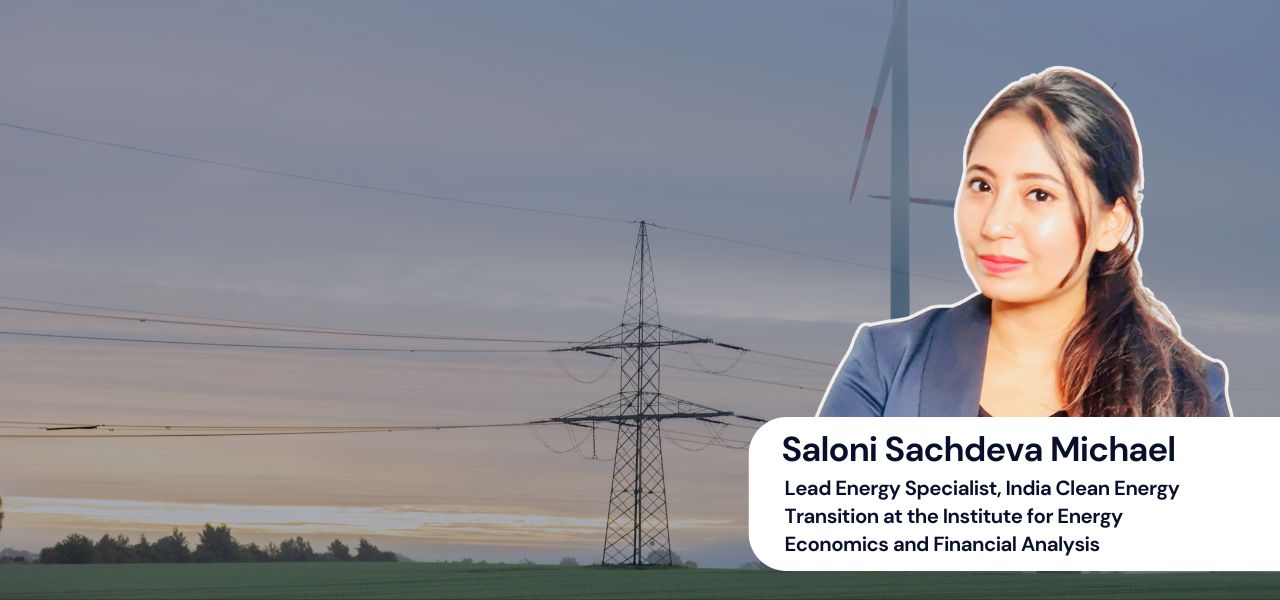
In the second part of our State Series, we take a data driven view of this transition. We spoke with Saloni Sachdeva Michael , Lead Energy Specialist, India Clean Energy Transition at the Institute for Energy Economics and Financial Analysis. Drawing on the recent India State Electricity Transition (SET)Report which she has co-authored, she explains how states are navigating the transition.
What seems like a linear shift reveals deeper operational challenges, from rising peak demand to the constraints faced by distribution companies. Tools like smart metering and demand side management are becoming central. This episode explores how India’s transition is a mosaic of state level pathways shaping the sector’s future.
Listen to the episode with full transcript here in English
[Podcast intro]
Welcome to Season 6 of the India Energy Hour podcast. This podcast explores the most pressing hurdles and promising opportunities of India’s energy transition through an in-depth discussion on policies, financial markets, social movements, and science. Your hosts for this episode are Shreya Jay, Delhi-based energy and climate journalist, and Dr. Sandeep Pai, energy transition researcher and author. The show is produced by 101 Reporters, a pan-India network of grassroots reporters that produces original stories from rural India. If you like our podcast, please rate us on Spotify, Apple Podcasts, or the platform where you listen to our podcast. Your support will help us reach a larger audience.
As India’s electricity transition gathers pace, the real story lies in the complexity unfolding across states. What appears straightforward from a distance, adding more renewables and reducing fossil dependence, quickly becomes layered when viewed through states’ lens.
In the second part of our State Series, we take a data driven view of this transition. We spoke with Saloni Sachdeva Michael , Lead Energy Specialist, India Clean Energy Transition at the Institute for Energy Economics and Financial Analysis. Drawing on the recent India State Electricity Transition (SET)Report which she has co-authored, she explains how states are navigating the transition.
What seems like a linear shift reveals deeper operational challenges, from rising peak demand to the constraints faced by distribution companies. Tools like smart metering and demand side management are becoming central. This episode explores how India’s transition is a mosaic of state level pathways shaping the sector’s future.
[Podcast interview]
Shreya Jai: Hello and welcome to the India Energy Saloni. I’m very delighted to have you here. You have been spearheading this very important report for India’s electricity sector for what, five years now. That is obviously our touch point for today’s conversation, but happy to have you here and looking forward to discussing this very vibrant and very chaotic sector of India.
Saloni Sachdeva Michael: Thank you so much. It is my pleasure to be present here and thank you for inviting me. And I also wanted to congratulate the entire team behind the India Energy Hour for completing five seasons and now you’re on to the sixth one. I can not even relate how much of effort goes into consistently contributing to the clean energy transition dialogue. So kudos to the entire team and I really look forward to the conversation.
Shreya Jai: Thank you so much. It is guests like you who keep us going and it is because of you that we are able to do such, you know, knowledgeable and insightful conversation. On that note, I would like to start this conversation with you. We would, our listeners would love to know your journey. You know, you have a very deep background into renewable energy, engineering and management and, you know, you also have an electrical engineering background. You have worked with a variety of places. You’re currently with AIFA. Can you tell us a little bit about your journey? Where are you from? Your academic background? How did you land up into this segment? Just please tell us a bit about yourself.
Saloni Sachdeva Michael: Sure. Thank you so much. So born and brought up in Delhi, but my clean energy journey started back in 2012 when I was pursuing my electrical engineering in Pune. And this was also the time when the Jawahlan Heron National Solar Mission was being launched and it aimed to establish India as a global leader in solar energy. And when I used to roam around in Pune, I could spot like a few solar panels here and there and some conversation happening around it. And it often caught my attention. And that curiosity around the solar industry combined with my core discipline of electrical engineering, it naturally led me to choose renewable energy as an elective subject during my course curriculum. And then that is where my journey in this space started. I would also like to say that a key personal influence was also my father, because at that point of time, he used to frequently travel to China for work. And he used to witness the entire solar manufacturing sector booming in China and trade happening around solar products. And often he would tell me, OK, there is a huge opportunity of business here. So I got into this space with the mindset that I will do business or some entrepreneurship solar home system work in the renewable energy space. But I think life had different plans and my journey took a completely different way and path after I did my master’s. So after my engineering, I was working with TCS for a year, but I knew I wanted to do something in the renewable energy space. So I started pursuing my master’s in renewable energy and management from Terry School of Advanced Studies. And I think during the course curriculum, my interest just deepened. And in my final year of internship, I got an opportunity to work on the relevance of mini and micro grids in ensuring that the energy access reaches the last mile consumers. And I think with that project, I got such a defining experience of visiting the rural areas of Uttar Pradesh, Bihar, Jharkhand, interacting with communities around understanding the energy poverty implications, affordability challenges, and then how actually renewable energy technology and its implementation could help. I think this was the pre-sahogia era. So the Sophagia scheme eventually in 2017 was launched and focused on universal household electrification. But at that point of time, it was more around how do we ensure the electricity or the grid is reaching these consumers. And I felt that there I got a lot of glimpse into how policy and regulatory ecosystem can define and what kind of in-depth impact it can have on communities. We often don’t think about it, but that linkage helped me understand that. And it also, I think, defined my journey going forward because after my master’s, I joined Shakti Sustainable Energy Foundation in the energy access space itself. So I got the opportunity to expand on that project, work with the Ministry of New and Renewable Energy at the national level. A lot of state, be it UP, Bihar, Risa, Jharkhand, at that point of time, they were developing their mini-grid policies. So understanding what kind of policy and regulatory ecosystem needs to come in, what kind of targets need to be set, what could be the role of state nodal agencies. So I think there my interest deepened in the policy and regulatory space. And I also got this enriching opportunity of working with different kind of stakeholders, be it policymakers, I think civil society organizations and a lot of philanthropic funding organization also. So, yeah, that was really interesting. Maybe another aspect I could highlight was during that entire five-year journey at Shakti, another question often I was very curious about was what would happen to these clean energy technologies at the end of the life. So I took a break post five years and fortunately I was selected for the German Chancellor Research Fellowship by Alexander Wann-Bohr Foundation. And there I worked in Berlin for a few months on marrying the concept of circular economy and clean energy decarbonization, understanding how the solar recycling ecosystem is developing in Europe, what kind of policy and technology interventions can happen. And I think I really feel that global experience further widened my perspective and gave me much more understanding of the space. And after I came back, I got the opportunity to work with AIFA, which is the Institute of Energy Economics and Financial Analysis. It’s a global think tank that works at the intersection of clean energy transition, supply chains and critical minerals. And it’s been the last four and a half years with AIFA have been really fulfilling, where I get to work on state level policies, supply chains, critical minerals and much more. But yeah, so maybe I’ll close by saying I started my journey thinking I’ll do business, but I ended up contributing in a more research and policy way. And honestly, I won’t have it any other way.
Sandeep Pai: Great. Thank you for sharing that. So, you know, obviously, from your experience, you collaborated, worked with different kinds of stakeholders, governments, think tanks, utilities, etc., etc. Has that changed your opinion about these challenges and opportunities of the energy sector? Like sometimes, you know, coming from technical point of view, it’s very techno economic focus. But then when you start interacting with the political economy, it changes. But I don’t know. I’m curious if just doing this interdisciplinary, multidisciplinary work has shaped your own thinking of the space.
Saloni Sachdeva Michael: Absolutely. I feel that the most valuable part of my journey was the opportunity to interact with the different kind of stakeholders, be it policymakers. And it just gives you a well grounded 360 degree viewpoint on the transition. But I just feel that the power sector evolves at such a fast pace that even you blink and you lose developments. So and from the outside, to be honest, when I started working in the sector, the energy transition looks quite like straightforward and linear that you need to move away from fossil fuels. You need to add more renewables and then you’re moving in the right direction. But when you start interacting with these stakeholders, you understand how complex and layered the process is. So I think that was a big learning for me. For example, conversations with the state governments and distribution companies, it helped me understand what are the actual on ground operational reality and what are the challenges they face. So it’s not just about adding renewable energy capacity, but they’re dealing with like financial constraints, ensuring that the supply is much more reliable. All consumers are getting electricity and even this becomes even more nuanced with different like demand patterns coming in with electric vehicles and data centers. Plus, I think another key perspective that I could highlight was how the peak demand in India is involving right now. So whenever you talk to these policymakers, you understand, OK, we were standing at a 190 gigawatt peak demand back in 2021. I think in a few months of May where it touched 250 gigawatt and now studies are expecting that it might touch 270 gigawatt this summer. And so the implication of like rising temperatures and cooling demand, how it impacts the state level procurement practices, the planning, the forecasting. So these are nuances that you might not think of in the first go. But then when you interact, you get to know about these challenges. And I feel it’s the job these state departments and distribution companies have a tough job in their hand. We often say distribution companies is the weakest link, but and the bad guys. But they have a really tough job to handle. And I think but things are working really well, I would say. India has managed to ensure that there are zero power outages in the last few years. And renewable energy is playing a big role. We now are accounts for approximately 51 percent of the installed capacity. And especially with the new storage around battery energy storage and pumped hydro coming in. So, yes, a lot is moving in the right direction. And it also, I feel, for example, I just want to take the present nuances around the global crisis. I think the well-talked-about discussion has been that multiple disruptions from Russia-Ukraine war or the pandemic and the present West Asia conflict leads to a lot of energy shocks that these stakeholders have to account for. And maybe they’re not prepared for. These are nuances that keep on coming in on their table and start impacting their job. In fact, we see that the oil and the gas prices are impact rising and then electricity will be the new fuel going forward. So, the transition is not about climate and energy security. And that understanding has evolved in these state players. And I think that has really helped me also build my understanding.
Shreya Jai: Right. Absolutely. And could you touch upon this work of yours? Because I wanted to get into it. And this recent report for our listeners is called the Indian Estate Electricity Transition Set. The 2006 version is just recently out. And it evaluates the progress of the states across several facets and dimensions of the transition that electricity sector is making. Very important segment when we talk about the country’s whole energy transition. Also, again, as you said, it’s usually called the weakest link. But this is where the real change will happen, which would kind of impact the whole supply chain. But to start off, I want to understand, you know, could you walk us through the framework which was used in the report? And, you know, what does it tell us where the key Indian states stand, where India as a whole stands?
Saloni Sachdeva Michael: Absolutely. So, maybe first a quick background around the journey of the report itself. So, the state electricity transition report started back in 2023. And this is in collaboration with AMBUR. And when we started, the objective was simple. That we wanted to build a data-driven analysis to track how India’s electricity transition will be unfolding. And though the national targets give you a direction, but the reality of the implementation and the action happens at the state level, be it planning capacity, managing the distribution losses, enabling the renewable energy deployment. So, with that context in place, we wanted to understand what is the progress and performance of Indian states in this transition. So, the first edition was released back in 2023, followed by another one in 2024. And then the third one few weeks back, as you were saying, in February 2026. That now covers 21 states. And when we started this work, I think the biggest question we were grappling with was, one, how do you define electricity transition at the state level? And second, what do you measure? So, what are the parameters you need to measure? So, I think after a rigorous process of making a laundry list of 100, shortlisting, and talking to a lot of experts in the sector, we shortlisted around 18 to 20 parameters. And then created this framework, which is now analyzing 21 states. It’s a three-dimensional framework with three dimensions across 18 parameters. But we are very cautious and aware that this is a dynamic and evolving exercise. And every year, we will have to put in the effort to refine the methodology based on like the data availability and the sectoral developments and the feedback we receive from the experts. So, if I can quickly touch base on the framework, because Shreya, that is something that you wanted me to highlight. So, the framework has three dimensions. The first one is decarbonization, where essentially we wanted to understand how well the states are moving away from fossil and accelerating deployment of renewable energy. So, what is the install capacity? How is the increase in the procurement mix of the state? What is the increase of share of RE in that procurement? To make this something we were looking into. We also are very cautious of the fact that the RE potential and the resource endowment at the state level isn’t same. So, each state has their unique potential. So, within that state, how well the state is utilizing their potential itself. And thankfully, that data was available in MOSPE reports. Another thing we wanted to understand was how well the states are accelerating energy efficiency interventions and also how much of investment, public investment is going in the development of the infrastructure needed for RE in the state. With all that perspective, one thing we were very crucial or aware about was that we never wanted to invent the wheel for any of the parameter. So, for example, for state electricity efficiency index, we knew AEEE and BE is already doing that index and capturing energy efficiency interventions. So, we would piggy bank on the data that was existing. And for other parameters, we were collecting like raw data from state departments and all publicly available data. The second dimension was more on to understand the readiness and the performance of the ecosystem in the state. So, how well the state is developing its distribution ecosystem. So, the performance of the distribution companies in the state. Is the state uptake of distributed solar energy happening? Then we also looked at what is the power educacy, what percentage of shortages are happening at the state level. Another parameter that we added this year was on smart metering because going forward implementation of time of day tariffs or DSM demand side management will require smart metering implementation. So, those were the kind of data sets we were collecting under this dimension. And last but not the least, under the market enabler dimension, we wanted to understand, okay, now that the decarbonization is happening, the ecosystem is developing, what is the policy and the regulatory ecosystem in the state? Is the state regularly updating their electric vehicle and green hydrogen policies or the industry policies? If the data is available, what has been the uptake of electric vehicles or the green hydrogen capacity in the state? We were also looking at storage deployment and capacity increase at the state level. And also, as I was mentioning, time of day tariffs, if the state is regularly including time of day tariffs under the tariff orders or not. So, I think a combination of these three dimensions formed the foundation and the framework for the study. And as I was saying earlier, it is a highly data intensive exercise. And we pulled together a wide range of parameters across states that required like cleaning and validation. And I think a lot of experts really helped. And a lot of those experts have been on this podcast. So, I really went back and have heard those people and their opinion also. So, I think maybe I’ll close by saying that even one big learning from the report has been that though we are analyzing the performance of the states, a big finding was that the performance is scattered. Each state is accelerating the transition on their own pace. So, the speed and the pace is quite different. And I think that’s the beauty of such kind of analysis. And it’s not necessary that only few states are leading the entire transition. I think now there are different buckets in which some states are contributing in their own way based on their own potential.
Sandeep Pai: Excellent. Thank you for explaining kind of the framework, how it all came together, your data sets. Actually, I have one more framework methodology type questions. And then it would be great to understand, you know, what your findings are and how states vary and why. So, the first part of my question is, I think any indexing, one of the biggest things is how you provide weights to those different indexes. And in your report, you know, you have provided different weights. Some have 25, some have 10. And so, this weighting actually kind of can really change the outcome of this. So, can you speak on how you arrived at these weights? And I think this is a good caveat and a really important sort of line in any kind of indexing methodology. So, I would love to hear your thoughts on that. And my second then question is like, can you explain your results, what you found?
Saloni Sachdeva Michael: Sure, I think that’s a very important question. And we were also very critical about how each and every weight to the parameter is assigned. So, since this has been the third iteration of the report, each year, we have a list of 10 to 15 experts to whom the methodology and the parameters and the entire data sheets are shared. And we get a lot of opinion and feedback on those weightages. And after combining the input from these experts, we define the final weightages. And after the, if you, I think all the data sheets are available on IFAS website. So, anyone can go and have a look at it. But if, as soon as you put the weightages, obviously the analysis and the final output will vary along with the weightages. We also share the final analysis with the experts to vet if they agree with the findings or not. And are the findings aligning with the present ecosystem in the state or how the states are developing? So, absolutely, it was a lot of to and fro, but it involved rigorous discussions with experts, a lot of averaging of input from 10 to 15 experts each and every year, every iteration of the report, as I was mentioning. Another aspect to this was that another input we received from stakeholders was around the nature of the parameter. So, few parameters would be progressive and few would be regressive. So, a parameter like RE potential where we say that a state, the more RE potential that the state occupies or utilizes, the better in the transition. But whereas in a, in case of a parameter like power advocacy, the more the percentage of shortage, it’s an inversely proportional linkage to the impact. So, there also we received a lot of input from stakeholders. And a lot of times, fewer of our parameters are a combination of different rubrics. So, there are some weightages and some assumptions there which are explicitly mentioned in the report. I would, anyone who’s listening to the podcast can go through it and happy to answer. Me and my co-authors can answer those questions later on. Maybe I will also take this opportunity to mention that this version of the report, we have also launched a data tool along with, in collaboration with Amber. So, where the objective is to ensure that all the raw data that the team has collected in the last three, four years is available for public use. And there are graphs available when you play around with the data, you get state-level analysis. So, that is also something that is now available.
Sandeep Pai: Thanks for explaining the methodology. So, if you can explain the findings, what did you find? And then we’ll go from there.
Saloni Sachdeva Michael: Sure. So, I think it’s very difficult to present the findings of such an intensive report. But I think the biggest key takeaway for us was that definitely the electricity transition is progressing well, but it is uneven across states. And it’s not surprising. We have been seeing that analysis and finding across the three versions of the report. And there are reasons why the entire performance of the state is different. Be it factors like I was talking about resource endowments. So, a state has different solar and wind protection and it will impact its overall score. Second, the financial and operational health of distribution companies will impact how the state is well equipped to ensure that the clean electricity transition is accelerating. I think another factor is policy and regulatory intent of the state, the grid readiness and institutional capacity. Because for integrating these renewable energy ecosystem at scale will require proper planning and coordination and investment in the grid infrastructure. So, based on all of these different aspects, I think our learnings were also bucketed under the three dimensions that I already talked about. So, for the first dimension, which is decarbonization, I think it was really interesting to see that states like Karnataka, Himachal Pradesh and Kerala stood out as leaders and high performers. If I take an example of Kerala, maybe okay, I’ll start with Karnataka first. Karnataka, the state has been performing well in the last two versions of the set report also. And the state has a renewable energy share of around 37% in its power procurement mix, which significantly lowers its emission intensity. The state has also performed strongly under energy efficiency interventions. And this is an input, as I talked about, we got from the SEI report from AEEE and BE. The state has also been able to install 24 gigawatt of renewable energy capacity. And it has been growing year on year. So, we have seen that the state’s progress in terms of the decarbonization numbers was really well. But having said that, still there’s a lot of potential because at present, only 4% of the wind potential and 39% of the solar potential of the state has been utilized. So, you can see, even though Karnataka is like the top performer under this bucket, still there is huge potential for the state to grow and contribute to meeting India’s 500 gigawatt target. And I think for that, we will see that their sustained policy position, institutional capacity will be required going forward in the state. Similarly, for Himachal Pradesh, which is more hydro dominated, we saw that the renewable energy share mix in the state, like is the highest because it stands at 65%. And obviously, because of the hydro availability in the state. And similarly, Kerala also performs really well, relatively in the power procurement mix and utilization of the renewable energy potential. So, these states really stood out as part of the analysis. Coming on to the second bucket, which is readiness and performance of the power ecosystem. It was interesting to see that Delhi and Haryana stood out in this dimension. I think Delhi was very interesting because despite of having like limited renewable energy resources available and obviously the land challenges available, the state has 24% of its renewable energy share in the procurement mix. And I think if I could explain that, it means that the total power consumed in that state out of that 24% is coming from renewable energy. And similarly, if you talk about distributed solar, that capacity stood around 300 megawatt in the state, which is around 76% of the total renewable energy capacity in the state. Another thing we saw in Delhi was that the shortages, the power shortages have almost negligible zero power shortage. And if the state was able to meet like a demand of 38,000 MUs in the financial year 2025, and that has been possible because of the distribution companies, the three discoms in Delhi performing well, they have had stable performance. But despite of that, I think few areas where we felt that improvement could happen in Delhi is, one was the state’s participation in like short-term market was limited. And second, there’s almost negligible or no smart metering installment under the RDSS. So the revamped distribution sector scheme has allotted and given smart metering sanctions and targets to each and every state. For Delhi, it’s not even started. So assuming that state starts doing that and then has the right TOD tariffs and demand side management principles in place, so we can see that there would be further improvement in the state. As I said, Delhi and Harana were examples. And Harana similarly has strong distributed solar adoption. The reliability and power advocacy in the state has improved. Maybe here I would also want to highlight a state, Bihar, which was unexpected for us and very interesting. Because in this particular dimension, Bihar performed exceptional under one parameter, which is smart metering. And it was one of the states who was able to achieve 78% of the smart metering deployment under RDSS, the revamped distribution sector scheme I was talking about earlier. And this is almost the highest in the country. And the state’s performance, though, despite having good smart metering, was constrained in terms of distributed solar uptake and even power outages. It still has like 0.4% of power outages, which seems a small percentage. But at the national level, it contributes to the national numbers. Yeah, I think these were the key findings from the second bucket. Coming on to the third bucket, which is around market enablers. There are states like Andhra Pradesh, Uttar Pradesh and Rajasthan emerged as leaders. Andhra Pradesh stood out because it has a strong policy and regulatory ecosystem with the industrial policy, EV policy, green hydrogen policy in place. The state has around 1.4 gigawatt of pumped hydro storage. And that adds to the state’s performance. I think it was also interesting to see that Uttar Pradesh shows a strong momentum in EV adoption. So the percentage of EV adoption was quite high in Uttar Pradesh. And similarly, states like Bihar and Assam were also worth noting because they have had a good RE capacity uptake at the state level. They have the ecosystem around tariff regulation. They are coming up with a time of day tariffs and EV adoption is accelerating in these states. So yeah, I think these were the few states that were really doing well under this dimension. But I think the big takeaway from the report was that going forward or at present, the transition is no longer about like few front runners in the entire analysis. It’s more distributed and it’s more complex where few states are performing under buckets. And that’s why we say there are some partial leaders and two-dimensional leaders. And going forward, a lot of work will be required to make sure that states are performing well across the three dimensions to ensure that the transition is accelerated.
Shreya Jai: Right. That’s quite a mix. There are some obvious names about the discoms, which are usually financially better off than the others and hence can take up, you know, reform measures. And then you mentioned some names of Bihar, Assam, et cetera, who in the recent years have thrown surprises on various fronts. And then you’ve highlighted these different buckets and dimensions and, you know, power ecosystem, readiness, market, decarbonization, et cetera. I have a two-pronged question. You know, why is there so much difference? Like what is what do you think is the reason that some states tend to do better than others? And what is the biggest bottleneck? What are some of the biggest challenges for states right now, which hampers their transition journey?
Saloni Sachdeva Michael: Absolutely. I think each state has a different bottleneck. I would just say that maybe the bottleneck is also not same across states. And that is why such kind of study highlights that. In fact, when we were doing this exercise, we wanted to go into further in depth of talking to state level policymakers and getting their input. For example, under the decarbonization budget, the bucket, you see that states like Bihar and Assam clearly see that the bottleneck is around low renewable energy share. And there even the potential utilization of wind and solar is limited. In fact, for Bihar, only 18 percent of its renewable energy share is in the procurement mix and only 3 percent of its RE potential is utilized. And similar trend we see for Assam also. But then on the other hand, the regulatory ecosystem or the smart meter development in the state is happening quite well. So what is not happening is interdisciplinary development, collective holistic development at the state level. And there the biggest challenge has been the distribution companies and their performance. And I think what we will also have to understand is that we cannot put all the states on a common platform because every state has had a different starting point. So some states come with legacy issues and there the transition might be slower on the start, but maybe it will accelerate as soon as the ecosystem has developed. For example, RE leader states like Karnataka, Rajasthan, Tamil Nadu, Gujarat, their journey started way back then. So that challenge will always exist in such states. I think another example I could highlight is of Karnataka. As I was saying earlier, that Karnataka was like the top performer and the leader under the decarbonization budget, the bucket. But as soon as we move into other parameters, we see that even though there is RE acceleration and deployment, but the state is facing constraints in terms of system readiness. The penetration of distributed solar energy is very limited at the state level. And for that, the big reason is smart metering deployment is almost negligible in the state. So even if the discom is working well, the transition is accelerated, smart metering is causing a big challenge. So I think a big takeaway was the transition, for the transition to happen, everything will have to move in parallel instead of performance in one siloed bucket over the other.
Sandeep Pai: Right. I just want to, this is, this is great. I just want to ask you one question. Like, having done this exercise, having looked at the spatial difference of, you know, performance of different states in terms of some are very good in some parameter, others are very good in others. There’s a lot of variation. I mean, let’s talk about the future. So what are some big picture kind of institutional frame and policy changes that, that you would advocate for in the states?
Saloni Sachdeva Michael: I think if we look ahead, I, one of the biggest shift would be, I hope in the next decade, we are not talking about the challenges we are talking about right now. And a big shift would be how the demand is growing. So at present, what we have seen is with the penetration of electric vehicles and demand centers, the demand is moving from being fairly predictive to much more dynamic in terms of the timing and the shape and the source of the demand. So a big part of what is coming up is how well the states will prepare themselves to ensure that the planning and the forecasting is happening in a way that this new demand from electric vehicles and data centers is managed. And also, I think industrial decarbonization and green hydrogen will also add to it. So just piggybacking on that, another aspect to it and the new dimension that is emerging is the relationship between AI and energy. So on one hand, AI and digitization will drive more efficient forecasting and grid management and better demand planning. But on the other hand, AI itself with the data centers will be a huge demand input for these distribution companies and state energy departments. So it will be interesting to see how the loop between energy for AI or AI for energy will develop in the next decade. But coming to your question pinpointed around what could be like the key priorities for the states in the upcoming decade, I think the first will be better and more digitized demand forecasting and planning. I’ve already talked about why we need that. Second, I feel the lowest and the most cost effective solution that is not utilized is demand side management. And we often focus on the supply side and the demand side is ignored. So tools like smart metering, time of day tariff and even aligning the time of day tariff with solar hours so that consumers are motivated to utilize and use power during the daytime when solar is available will shape how the trajectory of the demand will flow going forward. So, yes, so better, more improvement in energy efficiency and system efficiency. And that will also lead to ensuring that the peak demand that we’re seeing is managed much more effectively. Third, I would say grid modernization and flexibility. I think we have been talking about it since last five years and it will go on for another five because the more RE is added into the grid, the states will need to upgrade their distribution and transmission infrastructure. We have seen examples of RE curtailment because one short circuit at the DTE end. So I think these are technical investments that can really accelerate the transition and avoids such disruptions. And related to this and the point I was making earlier on peak demand would be the storage deployment. I think in the next decade, the storage, be it the battery energy storage or pump hydro storage will play a key role in how the supply and demand is balanced out. Next would be the financial and operational health of distribution companies. That is something is foundational. It will still play a key role in the next decade. Another thing I would like to touch upon is I think a huge opportunity at the state level is on the domestic manufacturing side. So we say that we want to achieve 500 gigawatt of RE. We stand at 266 gigawatt as of Feb 2026. So the next 200 gigawatt edition will require raw material in terms of lithium, cobalt, nickel, graphite, rare earths. And at present, most of that is imported from different geographies. And so here lies a lot of opportunity with states to establish one of the processing and refining technologies in India for these minerals along with recycling and the domestic manufacturing, which is already happening under Atmanirwar Bharat. And last but not the least is data transparency. And I cannot just not make that point because that was the biggest struggle and limitation in the report. Also getting I think we strongly believe in the fact that you cannot what you can’t monitor, you cannot improve. Also what you can’t measure and monitor, you can’t improve. So in order to do that, a lot of this complex data needs to be captured in a reliable and a real time manner. And that will be essential for better planning and decision making going forward. So yeah, I think these are the five to six points. And I would sum up by saying that the transition, I think I’m really proud in the way India’s transition is happening. And then if we are able to make the states the face of it and make it much more smarter, flexible and more responsive, definitely that will form the backbone of this transition.
Shreya Jai: Right, absolutely. One major, you know, if I may say criticism that the transition planning of this country has is that for like at least last two decades, the planning is usually done at the federal level and then trickles down to state. Like the center decides that this is the target 500 gigawatt and then just keep shoving it to the states. But as your report highlights and during this conversation, I realized that there’s so much happening at these states and the states themselves are planning their own transition. Developing, you know, developing, you know, customized solutions for themselves. There are tenders happening, there are storage planning, et cetera, happening. This is a little of a foresight question. But do you see the pyramid reversing in the whole energy transition planning in the country?
Saloni Sachdeva Michael: I hope it does. But to be honest, in the near future, I don’t see it reversing, but I see it balancing out. So the targets or the direction will still be set at the national level. But I think the contribution of the state’s voice as an input to that will increase. It already exists. I won’t deny that. There are mediums and processes with which the state’s voice is included, but it will accelerate. And in fact, I would want to go level deeper that district level planning. This will also become very crucial going forward. Yeah.
Shreya Jai: Great. What a way to sum it up. Let’s hope that that happens because that could be the real change. And we’ll be excited to see what happens on that front. And you’ll be excited what you observe and mention it in your report next year. Thank you so much for talking with us. It was an insightful conversation. We learned a lot and I hope this starts a lot of thought streams going forward across the sector.
Sandeep Pai: Yeah. Thank you, Saloni, from my side also. It was great chatting and always good to catch up.
Saloni Sachdeva Michael: Thank you so much. The pleasure is all mine. And I really look forward to more interactions in the future.
[Podcast outro]
Thank you for listening to The India Energy Hour! Subscribe to this channel to never miss an update. To drop us a feedback, visit our website or write to us at [email protected]
We are on Twitter. You can follow @tieh_podcast and get in touch with 2 hosts @shreya_jai and @sandeeppaii
[end]
Listen to the episode with full transcript here in Hindi
Guests

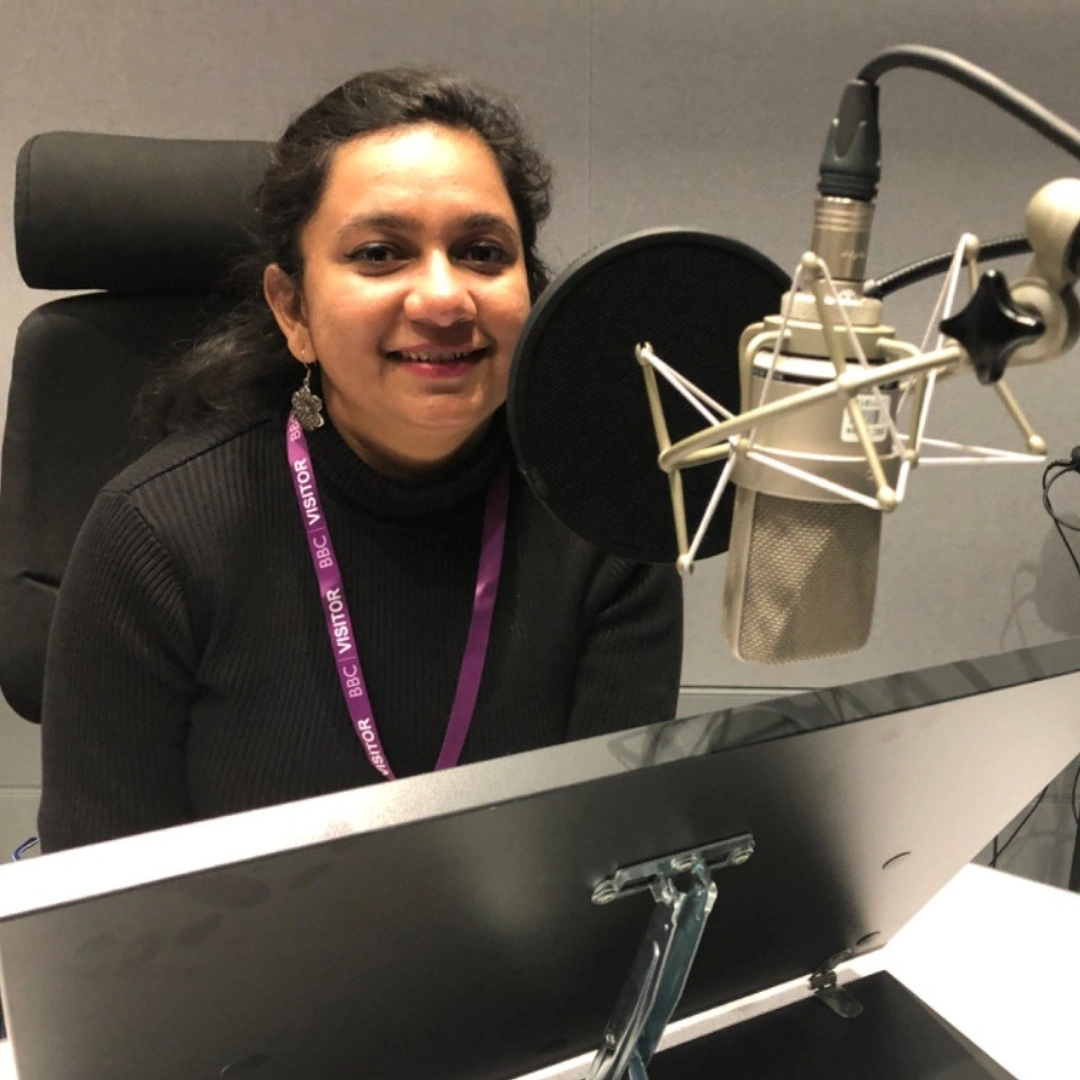
Saloni Sachdeva Michael
GuestLead Energy Specialist, India Clean Energy Transition at the Institute for Energy Economics and Financial Analysis.
Hosts