
As India’s energy transition accelerates, much of the real momentum is happening at the state level, where policy meets implementation. From electricity markets and regulatory design to industrial decarbonization and green growth, states sit at the center of how policy translates into action. But what does it take to drive large scale change within these systems?
We present a special series exploring the changes shaping state-level transitions. How can incentives be aligned across institutions, political and economic realities managed, and programs designed to be both ambitious and implementable? And as clean energy becomes increasingly cost competitive, what is shaping the choices states make today?
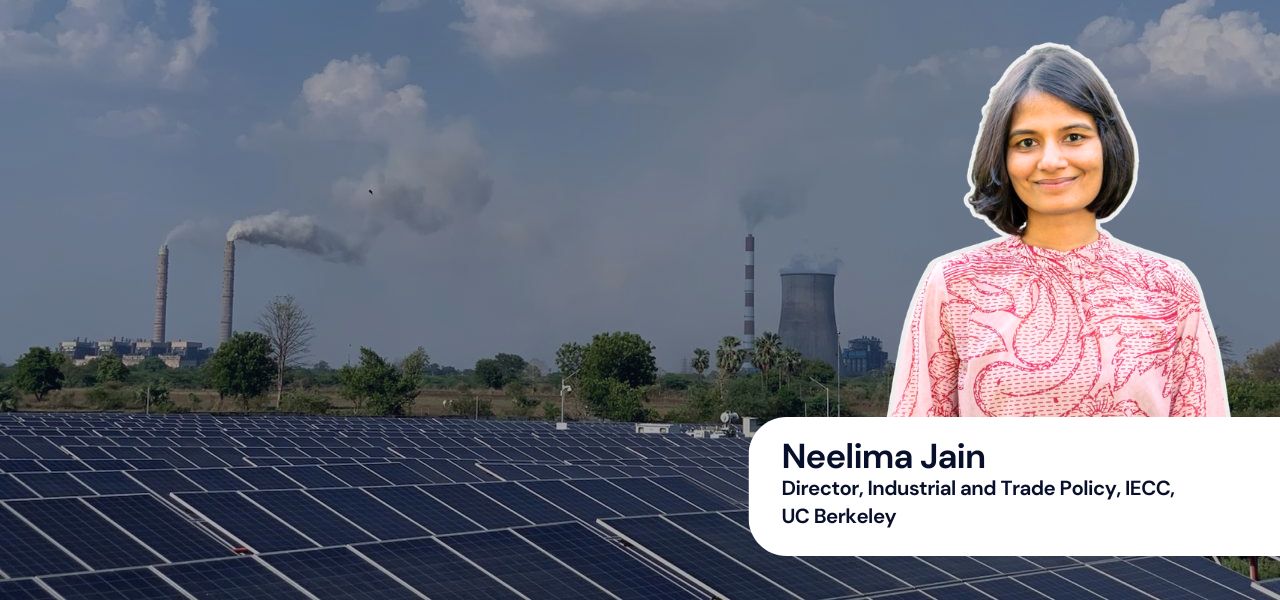
For the first part of the series, we spoke with Neelima Jain, Director of Industrial and Trade Policy at the India Energy and Climate Center at UC Berkeley. With experience spanning consulting, government, and global think tanks, she has played a key role in shaping and implementing some of India’s most significant energy efficiency and transition efforts, including scaling up UJALA and advancing international energy cooperation.
Listen to the episode with full transcript here in English
[Podcast intro]
Welcome to Season 6 of the India Energy Hour podcast. This podcast explores the most pressing hurdles and promising opportunities of India’s energy transition through an in-depth discussion on policies, financial markets, social movements, and science. Your hosts for this episode are Shreya Jay, Delhi-based energy and climate journalist, and Dr. Sandeep Pai, energy transition researcher and author. The show is produced by 101 Reporters, a pan-India network of grassroots reporters that produces original stories from rural India. If you like our podcast, please rate us on Spotify, Apple Podcasts, or the platform where you listen to our podcast. Your support will help us reach a larger audience.
As India’s energy transition accelerates, much of the real momentum is happening at the state level, where policy meets implementation. From electricity markets and regulatory design to industrial decarbonization and green growth, states sit at the center of how policy translates into action. But what does it take to drive large scale change within these systems?
We present a special series exploring the changes shaping state-level transitions. How can incentives be aligned across institutions, political and economic realities managed, and programs designed to be both ambitious and implementable? And as clean energy becomes increasingly cost competitive, what is shaping the choices states make today?
For the first part of the series, we spoke with Neelima Jain, Director of Industrial and Trade Policy at the India Energy and Climate Center at UC Berkeley. With experience spanning consulting, government, and global think tanks, she has played a key role in shaping and implementing some of India’s most significant energy efficiency and transition efforts, including scaling up UJALA and advancing international energy cooperation.
[Podcast interview]
Sandeep Pai: Neelima Jain, Director of Industrial and Climate Change Neelima Jain, Director of Industrial and Climate Change Neelima Jain, Director of Industrial and Climate Change Welcome to the India Energy Hour. I really mean it. I have been wanting to have you for a long time, but it’s just somehow things haven’t happened. But I’m really happy that we could make this work and really excited to have you and to have a good chat for the next hour.
Neelima Jain: Thank you, Sandeep. It’s great to be here. I think you’ve built something really special with the India Energy Hour. So I hope I can keep up the standard. And I think you’ve also invited my former bosses, both Rick Rosso and Saurabh Kumar. So clearly you have excellent guests. I’m really looking forward to the conversation.
Sandeep Pai: Excellent. So we have a tradition. And as you know, we like to talk about the person for the first little while. So to understand, because everybody, I keep saying this, everybody in the energy and climate space has such a different and diverse journey. Our generation, if I can say, didn’t have traditional training in energy. Most of us, we somehow got into X and Y and Z topics within energy and then stumbled upon these topics. So tell us about like your, you know, where are you from? What did you study? How did you get into the energy space? And then I will have some specific questions about how you set up one large unit in UK and then your role in CSIS and so on and so forth. So let’s just start from your like kind of your beginnings.
Neelima Jain: Yeah, sure. Thanks. So I’m a software engineer by training. And in my entire software career, I think I wrote one data query, just one. So that was like the start and end of my glorious coding career. Clearly, the universe had other plans for me. So my first job was at Wipro. This is around 2003. And I was placed on a project for National Grid in UK. At the time, it was the largest gas transmission company in Britain. My job was software testing. So, you know, testing is very sounds and glamorous, but it’s actually a phenomenal way to learn a business. You know, your entire job is to understand processes and deeply enough to find falls in the software. So before I knew it, I understood how a gas transmission utility works, you know, scheduling, dispatch, market design. And that was my gateway into energy, though I did not realize it at that time. Then I moved to the client side in the UK, which gave me a firsthand feel of the utility world and, you know, the gas markets there. Then I worked with some of the other utilities like water utilities. And then I joined IBM in India as a management consultant. Again, advising energy clients like Torrent Power, GSPC Gas, also Tata Mundra. It was all about just improving their business processes, you know, optimization. I went back to the UK from IBM, worked on a smart meter rollout. So, yeah, it was really my first taste of demand side energy. How you think about the consumer and not just the supply side. But here’s the thing. After nearly a decade of like this consulting business analysis, I really started feeling a bit restless. You know, you’re writing slides about transformation, but you’re not really doing it. So I did make a now that I look at it, I did make a slightly terrifying decision to leave the consulting world. And then I’ve been very fortunate, you know, just finding the right people at the right time. I joined this company called Sequest Capital, which was, again, a carbon finance company led by Ken Newcom, you know, who was who for those who don’t know, was like the former head of the World Bank carbon finance unit. He essentially designed the first global carbon fund. So, you know, working with him was like a masterclass. And Sequest was actually rolling out these large, what are called as the Clean Development Mechanism Program. So basically, CDM, for your listeners, was this Kyoto Protocol instrument where, you know, developed countries could invest in emission reduction projects in developing countries and earn carbon credits. It was really the first sort of global architecture for putting a price on carbon. And my job was planning this large program called as Bachat Lampiojna, which was basically replacing the incandescent bulbs. My life has always been about bulbs, you know, and we will come to that. So replacing the incandescent bulbs with CFLs, which was generating carbon, you know, credits. And at that point in time, CFLs were, you know, the most efficient technology, lighting technology and were commercially available. So and we were generating these carbon credits from the energy savings of each of the bulbs that were being replaced. So you had to track every single household, like every single bulb. So there was this rigor in what is called as the measurement reporting and verification, which I’m sure a lot of your listeners would learn about, you know, MRV. And this was such a grounding experience, literally, you know, knocking on doors in Kapoor Tala and Amrit sir and Kuntur, doing surveys, understanding how programs actually work at the grassroots, very different from the consulting rooms I came from. But more importantly, I learned what not to do when running a large scale program. And then what happened was that the carbon markets crashed. This was in late 2012, and I was laid off, you know, when you’ve been running nonstop for like nearly a decade, suddenly having nothing on your calendar on a Monday morning is its own kind of shock. But I decided to just slow down. There’s no other option at that point in time. I just traveled around the country. I discovered Hampi, among other places, which I highly recommend, by the way. It’s one of those places that puts your career anxieties in proper perspective. And then this is key. I did a stint of voluntary work with this brilliant social enterprise in Bangalore called Pollinate Energy. It was run by a group of really bright, incredibly thoughtful women from Australia. What they were doing was training local community members. They called them to, you know, distribute and install solar lighting houses. Sorry, solar lighting systems and efficient, you know, cookstuffs in Bangalore, urban slums. So they were converting some of these, you know, people into micro entrepreneurs. And that experience was such an education. I didn’t know much about urban slums. So you grow up in India, you see them, but you don’t really see them, you know. And what struck me was how much we take for granted, you know, light, safety, the ability to just go on with your life after the sunset. These families were spending a significant part of their incomes on kerosene just to have a few hours of, you know, of terrible polluting light. And then you hand them one solar lamp and it extends their day, you know, their children’s are studying after hours. And it made me realize how fundamental energy access is. It’s not an abstract policy problem. So by early 2013, I was ready to go. I had actually decided on a business venture. And then, you know, life does this. I get a call from GIZ, which was a which is a German, you know, multilateral institution. It’s been working with Indian governments for very long now. It has a long history. So I get a call from GIZ for an interview. And I almost didn’t go because, you know, I had not done an interview in years and I was committed to my startup idea. But I thought, well, why say no to the experience? So I walk into the room and there are four interviewers. And sitting there is Dr. Ajay Mathur, who, as you know, was at the helm of Bureau of Energy Efficiency and is one of the most respected figures in India’s energy sector. And I’m like, which role is this interviewer is I’m interviewing for? You know, I was pleasantly stunned. Also, also on that panel was, you know, Saurabh Kumar, who had just finished about a year at ESL. So we had a fun interview. And the next thing I know, the venture idea is out of the window. I’m deputed to ESL via GIZ. Now, what happened at ESL is a completely separate story. Life changing. And I know we will, you know, get into states and why they matter. But let me let me just give you a very quick version. That first year was rich in learning, you know, just navigating the government paperwork, the note sheets, the boardrooms, which I must tell you are very different from the corporate boardrooms. And I’m sure you know this better than I do. I was used to very different boardrooms in my consulting days. I worked with state energy departments on demand side management plan. And of course, we started building what would become Ujala and the National Street Lighting Program. I think in 2014, we launched the first pilot in Pondicherry, which was like 300,000 bulbs, which was a huge amount at that point in time, like a big size for the industry. And I think with the first procurement itself, the prices just dropped by like, I don’t know, 38, 40 percent of LED bulbs. I remember at that time, the LED bulbs were being purchased at 800 rupees and we were getting incandescent bulb at like 15 rupees. So, yeah, more states came on board and with the change in the government as well, you know, there was the Honorable Minister Piyush Koyal, who was at the helm of Ministry of Power. He took note and then the Prime Minister launched Ujala in 2015. So, so I let the rate roll out for about, you know, three, four years. And yeah, there are many big lessons to learn from that. And I’m sure we will get into that. And then I think it just there was the very few success stories about energy efficiency at scale. So Ujala really became a big success story, not just in India, but globally. So I think the minister at that point in time was interested in seeing how we can replicate it outside India, especially in the in the West. So, yeah, I was sent to look at, you know,
Sandeep Pai: why is that, Nilima? Why? Why was their interest to replicate it outside? I’m just curious.
Neelima Jain: Yeah, because I know I remember one of the reasons I think the minister used to give was I think during his travels, many travels, he did see a lot of energy wastage, you know, in the US, in the UK. I think it was very odd for him to see the buildings were lit up, you know, after work hours. And I think an energy and Ujala became and street lighting program became such a success in India. And he wanted to make sure that he could replicate that success elsewhere. You know, an idea from an emerging economy, which is such a big success, you know, without any subsidy, just on smart design and public infrastructure, public institutions, to see how this could be replicated elsewhere. I think that was his motive. So, I was sent to look at, you know, UK and France. And I often joke when I landed in the UK, I had no team, no office, no plan. But we found good partners. And over time, of course, we didn’t do Ujala, but we set up ESL’s UK subsidiary and acquired a combined heat and power company, like a tri-generation company, because we saw potential for waste heat recovery in India’s industrial sector. So, that was the first overseas acquisition by an entity under India’s Ministry of Power. So, I did three years there. We, you know, we acquired a company, we ran it, and it actually became one of the biggest success in a UK-India sort of a relationship, and one of the fastest growing companies, you know, in two, three years. And after that, I moved to DC, joined Rick Rosso at CSIS. Again, I’ve been very fortunate at finding the right bosses. So, where we did a lot of work on US-India state-level cooperation, you know, on renewable energy, electric mobility, clean energy, thanks to you on Just Transition. And now I’m at the India Energy and Climate Center at UC Berkeley, which I am genuinely excited about. You know, it’s an incredible set of people, many of whom I’ve known since my ESL days. And each of them, you know, are expert in their own right and have shaped India’s power markets in more ways than one. So, to be working alongside them on industrial decarbonization and trade is just gratifying.
Sandeep Pai: Which is your favorite? It’s a trick question.
Neelima Jain: Oh, it’s the most obvious answer. I mean, clearly, Ujala is once-in-a-lifetime opportunity. And then also the acquisition in UK was, again, it was a great experience, you know, to be managing that and leading that acquisition, looking at the financing side of it. And then I think there are so many cultural differences, but in terms of just trying to see how we integrate, you know, it’s a great, it was a great learning. So, I’ve had many steep learning curves.
Sandeep Pai: Just one, kind of, you have such a long and, like, really, I want to almost call you a polymath, just from consulting to government to think tank in DC to now university think tank. I hope I’m reflecting the right way. I’m describing UC Berkeley work in the right way. So, it’s really, like, you know, variable, multiple types of different entities you’ve worked with. Do you think that energy work has become easy? Like, I’m thinking about somebody who wants to join now and build their career in the energy space. Like, I remember 10, 12 years ago, engaging with policymakers used to be very hard. I’m not saying it’s easy. It’s still not easy, but it’s easier. But I wonder, I would love to hear, you know, from the last two decades, do you think it’s become more people, policymakers are more aware about energy challenges, climate challenges? And I don’t know if you want to reflect on how that has evolved.
Neelima Jain: Yeah, I think so. I think so. I have to say the awareness has been much more wider across the value chain, right? Like, it’s not just the government. It’s not just the energy secretaries. It’s not just the middle management. But I’m also talking about younger generation. I think I’m, I almost, at times, I’m so humbled by looking at when I come across so many of the younger, you know, so many of the youngsters who are so passionate about the energy sector, I find now the aspirations are also shaped around energy sector. I don’t think I saw that that often when, you know, about 15, 20 years ago. So I think it’s working both ways. It’s not just the awareness. It’s also the education. I guess the proliferation of technology has helped. There’s a much more connected world. Working with the government has become easier because I think they, you know, again, each stakeholder in the value chain has got a more nuanced perspective. Also, I have to say that we have become, you know, we as in this community, this ecosystem have become much more aware of the role of states, which was so critical, right? I mean, now, at least not in the last, not before, you know, when I was, when I was working in ESL, I did not see as much engagement at the state level. But today, they’re very far and few. I mean, like, I can’t, of course, especially, you know, acknowledge the work of entities like Prayas who were working at the state level, at the grassroots level. But I think today now it’s much more, it’s been, you know, replicated. There’s much more wider engagement, deeper engagement. And so I think that also has brought in more awareness. So yes, it has become much more easier.
Sandeep Pai: Fascinating. I want to get into this topic of states because I know you have so much to say. So let’s just start from the baseline before we get into like real topics. Why do states matter, especially from the lens of energy and climate? Why does it matter? It’s something we used to talk a lot about at CSIS, but love, would love to, I just want to set the baseline so we can then build on that.
Neelima Jain: Yeah. I think let me start with the very basic, the fundamental, the constitution, right? Because that’s where the answer really begins. So, so under the Indian constitution, electricity falls under the concurrent list, meaning both the center and the states can legislate on it. But in practice, states are the ones running the show. Most electricity distribution companies, the discoms, they are owned and administered by state governments still. Hopefully that will change. But states really signed the power purchase agreement, right? They set the tariffs through their electricity regulatory commission. They manage the billing, the infrastructure and even the renewable purchase obligation, the RPOs. The center can set national targets, but the authority to act, to actually build, deploy and enforce lies overwhelmingly with the 28 state governments. And this is not just an electricity story, you know, land which you need for solar parks, wind farms, transmission corridors as a state subject. Water, agriculture, local governance, all of them are state subject. So when the prime minister announces, say, a target of 500 gigawatt of RE by 2030, the delivery of that promise runs through the state capitals, not Delhi. And then there’s the fiscal side, right? India has a finance commission that determines how central tax revenues are shared with states. Currently, I think it’s around 41% that goes to the states. But then states also have their own revenue streams, their own fiscal pressures and their own political compulsions, right? A state chief minister facing elections is thinking about electricity subsidies, industrial tariffs and jobs. It’s she or he is not thinking about meeting an NDC. So local voters are far more important to a state government than global climate commitments. And I saw this firsthand with Ujala. The prime minister launched it nationally in January 2015. And I naively thought, great, it’s launched. Now it’ll just roll out. But every single state had to be convinced separately. You know, some states were enthusiastic. Some were indifferent. Some were actively resistant. So the political dynamics, the discom finances, the local bureaucratic appetite for a new program, it just varies enormously. We had to knock on the door of every state, customize the approach, work with their political leadership, regulatory commission, their energy departments. So the national launch was just a starting point. The real race was run state by state. So to summarize, India’s constitution is designed in this way. You know, the fiscal architecture then reinforces it. And the political reality confirms it. States are where India’s energy transition will either succeed or fail.
Sandeep Pai: Right. Just in the same light, I’m wondering because, you know, at CSIS, you were leading work looking at comparing or bringing together U.S.-India states. How is it different when you compare a U.S. state and just reflecting on your partnerships between California and other units, Carnatica? How are they different? How are they similar in terms of just configuration, the authority they have in terms of, you know, energy transition or energy and climate policy, etc.?
Neelima Jain: Yeah. So, yes. And this is something I’m quite passionate about because I’ve seen it work. You know, at CSIS, we spend a lot of time on this. The basic insight is simple. The challenges Indian states face in, say, deploying renewable energy or modernizing grids, managing even the coal transitions, they’re not unique to India. You know, U.S. states, they face structurally similar problems. And also, there are a lot of parallels between what is mandated, what the U.S. states are empowered to do and what Indian states are empowered to do. So, the specifics differ, but the categories of problem are remarkably common. Grid flexibility, land use, energy access, workforce transition, financing. It’s all the same. And, Sandeep, again, I have to acknowledge your work here. Your research on just transition is something I’ve followed closely and it’s just one of the best out there. And it was actually thanks to you, you know, that I got the opportunity to also work on the CSIS project, just looking at just transition across India. So, and what struck me, and this, we also included South Africa in it. And what struck me, and I’ve said this before, was really just the similarities despite the vastly different contexts. Just ensuring the reliable, affordable energy was like the top priority everywhere, despite the economic context. And just communicating the transition effectively to stakeholders was a challenge everywhere. You know, the financial and political constraints on managing transitions were common across all geographies. So, it’s fundamentally a localized, inward-facing process. But then, I think the tools and the strategies can be shared. So, on the U.S.-India side specifically, there were natural pairings. You know, California has been grappling with high RE penetration on its grid for over a decade now, managing curtailment, storage procurement. And if you look at India, Tamil Nadu, Rajasthan, they’re facing similar challenges as, you know, their renewable penetration grows. And there was a lot to learn from their experiences. Not copy it, but learn from it and adapt it. But it goes well beyond California. Texas is now the largest solar market in the United States, you know. And it runs a deregulated grid with massive RE integration challenges. Gujarat, Rajasthan face structurally similar issues at scale. Colorado is, again, an interesting story. It has become the number one state in America for EV adoption, right, driven by their own zero-emission vehicle mandates. So, there was a lot to learn. Indian states developing their own EV policies. I mean, at that point in time, we were trying to pair them with Colorado. One interesting story was Massachusetts was really interested in, you know, how Tamil Nadu created success with their two-wheeler EV vehicles. And then, you know, this is what, you know, that really surprises me. Florida was keen to learn from Odisha’s grid resilience practices. It was really a two-way street. It has to be, you know, workforce environment. And so, I think even in the just transition, the coal communities around West Virginia and what we saw in Jharka and Shattisgarh at an early stages of, there were similar conversations. So, yeah, there are a lot of similarities. I think the most promising model I’ve seen is when you pair specific institutions, not just governments, right, like a U.S. state grid operator with an Indian state Lotus Path Center. You know, a national laboratory with an energy department in India. When the exchange is technical, specific, you know, it’s sustained, it works. When it’s general and ceremonial, it doesn’t.
Sandeep Pai: No, that’s a very, I have the same experience. It has to be as specific as like a specific policy or a specific document that that’s where the pairing happens. Great. So, let’s go a bit deeper on the India side. I just wanted to create these baseline questions first. So, I mean, the big, big question is all in India wants to grow. All states wants to grow, create jobs. And while states have two pathways or rather many pathways, but, you know, obviously there’s many pathways, but two kind of buckets of pathways. One pathway is you continue on relying on fossil fuels business as usual. It’s easy. There is no disruption. You know, you can, you don’t have to do anything extra or new or experiment. The other pathway is, you know, you embrace this low carbon world. That doesn’t mean in India’s case anywhere no one is phasing out anything. It’s just, you know, you build your new growth at first and then overall system in a low carbon way. Why would a state government take a risk? Why would they, like, it’s so easy, as you were saying, like, you know, if I’m a state chief minister, why would I just not, like, take the easy path forward rather than, I mean, we have to say, like, this is, this is not a done deal. The other pathway, it’s a bit uncertain. There are lots of positives, but there’s also, like, okay, what will happen? What will happen to the grid? What will happen to other things and things? So just a big picture political economy question. Why? What is the incentive if I am a leader of a state government in India?
Neelima Jain: Okay. So something fundamentally has shifted, Sandeep. I understand where this question is coming from. But today, the context is so different. So India’s, you know, clean energy and storage costs have dropped to a point where three goals that were traditionally seen as trade-offs, energy security, economic competitiveness, and sustainability. They’re now all converging. So India today has the lowest solar costs among all major economies. It’s about 2.5 rupees per kilowatt hour. And I think ICC’s analysis also shows that there’s, like, a solar plus storage that can deliver, you know, round-the-clock clean power at a much cheaper rate than a new coal plant. It’s under, you know, 6 rupees, under 5 rupees. So these are 25 years long, fixed tariff, no fuel inflation contracts, right? And India is now adding about, what, 40 gig of renewable capacity annually. I think a state that procures this power is simultaneously reducing dependence on imported fuel. We are spending $180 to $200 billion every year on importing, you know, coal, gas, oil. And so you don’t have to choose anymore. And none of this is happening in a vacuum, obviously, you know, these cost breakthroughs are translating into real action because states are driving the momentum. Gujarat and Rajasthan were already ahead of the game. You know, their land policies, bid designs made them natural magnets for renewable energy investment. But now you’re seeing that happening across several states. So, for example, Madhya Pradesh just got a cabinet approval for an RE procurement with 24-hour storage. Maharashtra just floated at 2.5 gigawatt of, it’s huge, 2.5 gigawatt of RE tender. So these are state-level decisions, right? The center is setting the framework, but it’s the states now who are creating the demand signal. They’re running the tenders. They’re building the pipeline. But the opportunity goes well beyond cheap power, right? India’s low renewable cost gives it a structurally competitive advantage in sectors like green hydrogen. Our estimates put, you know, a delivered green hydrogen of around $3 per kilogram, which is by European benchmarks are at least twice. You know, European benchmarks are at least twice as high. So that flows directly into green industry. You know, we are able to, we’re just finishing, we’ve just finished an analysis and we’re just about to publish it. The green hydrogen based steel making in India is reaching cost parity with new blast furnace steel by 2030. So India is able to now produce green steel, actually near zero emission steel at the lowest cost than any major international competitor. And if you count in these carbon border adjustments that are now becoming more and more stringent, we are actually one of the most competitive producers of green steel across the world. And all of that development has to happen at the state level. You know, this is where Eastern India comes in. India’s heavy industry backbone, you know, rich in iron ore, bauxite, copper. And with their existing rail and port infrastructure. Combine that mineral endowment with the world’s cheapest clean electricity, and you can start building green industrial corridors. It’s a real economic diversification opportunity. So, but it won’t happen automatically. It requires serious investment in killing and integrating new industries with existing communities. And in making sure the transition just creates that pathways for the people who are already there. And just creating a conducive policy environment. So, so to some, it’s not a choice. You don’t have to choose one way or the other. It’s all integrating. And thanks to India’s institutional capability, we have, there are no trade-offs. Right.
Sandeep Pai: No, that completely makes sense. And just economics of all this just makes sense. So, it’s the right thing to do. I’m just curious, but is, and I’m asking some big picture questions. I will ask you some policy questions. But like, when you work with states, and this is just throughout your journey, are there players who are still skeptical? Who are still in that old traditional thinking? And you don’t have to name names, but like, what is their argument still? If there is an argument to that, or that has completely shifted in states that you work with?
Neelima Jain: Yeah, I have to say, and I used to start with a pleasant surprise, but it’s not a surprise anymore, Sandeep. I think we have seen such a change in their attitude and openness and acceptance of clean energy solutions. I’m sure there will be states where there are not larger volumes, where, you know, conventional power is still cheaper. But at the individual level, even at the institutional level, I think what we have seen is the story is becoming more and more positive. There is more acceptance. There are more and more procurement momentum coming out of states like Odisha, you know, states like Madhya Pradesh is doing much larger tenders. There is Uttar Pradesh. So, you know, states that we never thought would turn around, they’re doing it on their own, you know, again, based on the awareness, the collective work of the ecosystem, I think, is now showing results. I am much more positive about it. Now, yes, if you had asked me this about three or four years ago, I would have had a specific answer. But today, I think the story has changed and largely based on the economics. See, at the end of the day, the business of sustainability has to be sustainable. And that can only be done if there is an economic case and there is an economic case. So, yeah, climate change, climate action is an additional benefit now, which I’m very glad about.
Sandeep Pai: Right. And how do you approach working with states? So, suppose you have a really interesting model, really interesting tool that a state can use. Do you go right at the top? Do you go with a specific department? Do you do a mix of both? Because even if sometimes, you know, the big boss is ready at a state, sometimes you see so much resistance from sort of not so much resistance, but it’s like extra work for them or extra things for them. So they could be slow and so on. I mean, at least this has been my experience. So how do you approach and I really genuinely want to learn this because you guys are like at the top of your game when you do this. So like what’s your strategy or model that has been successful?
Neelima Jain: Oh, wow. It’s I think it’s a different story with every state, but but I and I’m going to state the obvious. You have to just pick your champions. See, I have to say. I’ve met some of the sharpest, most committed minds, and I’m sure you can say the same, you know, working in the government. These are people doing extraordinary work with genuinely limited resources, often operating in silos, not because they choose to, but because the system is designed that way. And they understand something that global narratives often miss that that the transition is not just about energy. It’s deeply interconnected. And I think just on that principle. We have had multiple approaches. It’s it’s bottom top, top to bottom. So for a state, we have worked with we work with the energy secretary. Yes, because, you know, she or he is at the helm of decision making as far as energy energy policy making is concerned at the state. But at the same time, we’ve also started working very closely with the industry secretary, with the industry department, then with the finance department, because they they obviously hold the string to the person. There is much more. There’s more work to be done in terms of raising their awareness. Again, the incentives. Just because, you know, in an emerging economy, the incentives of all the departments are not aligned. However, when you go back to the chief secretary, there is a social incentive. That social incentive may not exist in departments like energy or in finance because it’s not their fault. That’s how the system is designed. So I think we have we have looked at all the levers and wherever we think that we need more champions, then we widen our reach. You know, and then, of course, the political will is so important. But it shouldn’t stop at just turning the political will, because at the end of the day, it’s the administration. It’s a bureaucracy who is going to move the paperwork. So you have to take them along. So I think it works in parallel. It is it really depends upon if you’re able to find a champion who’s able to sort of convene, navigate. And if you’re not, then you find more champions. So it’s it’s a very state to state or department to department approach. And it has it works most of the time. It requires a lot more patience. And I’m sure you know this as well, Sandeep. But it works. It’s working.
Sandeep Pai: I like your optimism. Really, it’s it’s very it’s very refreshing. Interesting. Let’s just talk about some policies over the years. What would you say are some policies that have really helped shape this economics of low carbon question that has really helped? Either at the state level or something that happened at national level. Is it about net zero target? Is it about, you know, 500 gigawatt targets? Or is it other sort of policies that have really shaped to to make states more interested in the low carbon pathway?
Neelima Jain: That’s a great question. Let me let me start with some state examples and then I can go back to national examples and I’ll be biased. I will start with Ujala. But but on the states itself. Right. Let me I mean, what I find exciting is how different each each state’s entry point has been. You know, let’s talk about Gujarat. So Gujarat launched its own rooftop solar scheme back in 2019, years before the national BM Surya Ghar scheme came along. And by the time the national policy arrived in 2024, Gujarat already had the vendors, the discom processes, the administrative machinery. And I believe the result is that 85 percent of applications now convert to installation. The national average is that is like 23, 25 percent. So that’s what happens when, you know, a state is building the ecosystem first. And then behind it is the usual Gujarat story, the feeder separation, the metering, the low losses and no subsidies on tariffs. Right. So Gujarat has had that institutional capability or that vision from the start. Maharashtra. Maharashtra’s regulator has historically been very, very progressive. And that really matters. Right. They were the first state to notify demand side management regulations in 2010, even before the forum of regulation issued the model. And then I think more recently they’ve done resource adequacy, you know, regulation, then demand flexibility, etc. But I think it’s important to acknowledge that Maharashtra’s regulatory progressiveness did not just happen in vacuum. Again, you had organizations like Prayas, individuals like Balwan Joshi, Mahesh Patankar, and I’m sure I’m missing out the names for many more individuals. They have done their share in shaping the regulators, you know, direction over many years. That kind of sustained, informed, you know, civil society engagement with the regulatory process is something I greatly respect. And I think it’s part of what makes Maharashtra’s story so distinctive. And Odisha is one I’d flag. I’d mentioned this earlier. Like Gujarat, it doesn’t subsidize electricity tariffs. And it has the lowest incremental green tariff in the country. You know, it’s put in place a very strong RE policy and a green open access rules. But again, what impresses me is their grid resilience story. They are one of the most cyclone-exposed states in India. And I think after the 1999 cyclone, it built the first state disaster management authority in the country. So the power sector resilience work there that they have done with Tata Power is, again, considered like a national model. Just to put things in context, what used to take and, you know, this is what I’d heard from the Odisha officials is what used to take days or weeks. They are now able to restore power within 48 hours after the cyclone. So for a state that, you know, most people associate with coal and heavy industry, I think it’s quietly building the conditions for a very, very different kind of future. So, so many great lessons, you know, from each of them have different starting points, but just based on their own strengths, on their own institutional capabilities and their own champions. Each of the state has been able to sort of show a strength. And I think that has helped other states, you know, replicate some of the stories. I think nationally, I think this demand aggregation story, again, so I will go back to Ujala, right? See, there are, again, just the, it hits you when, you know, you’re in, say, a Pudducheri or Andhra Pradesh or Assam. So the culture, the bureaucratic rhythms are completely different, but just three operational lessons from Ujala, which I think some of which have been replicated elsewhere as well. So first is the demand aggregation model. That works, but it only works if the government is willing to take and market risk, right? So in Ujala’s case, ESL used its own balance sheet to aggregate demand, to procure LED bulbs at scale. And then the prices came down, right? The procurement prices fell by 90%. The numbers are staggering, and I’ll not get into the numbers, but just in terms of the market transformation through sheer volume, what was really being solved was affordability access and just de-risking the new technology. And so a public institution stepped in to bridge that gap, just absorbing the technology risk and letting the volume drive cost down. And if you look at what’s happened since, the same template is now being used across India’s, you know, transition. So Secchi’s reverse auction for solar, VIN, use the same logic, aggregate demand, create a credible offtaker, let competition drive prices to levels nobody thought possible. It’s being extended to green hydrogen, ammonia, battery storage. So Ujala was the proof of concept. And I think the model has legs well beyond light bulbs. The other was execution. Execution is always harder than just procurement, right? I remember at its peak operation, we had like 2,500 to 3,000 distribution kiosks running across all 29 states. So it was, and each kiosk was a small operation, right? You’re recording, measuring, coordinating the supply chain across the country. So yes, the implementation also has its own elements. And again, I have to credit the phenomenal young people who are at the heart of the Ujala team is just a phenomenal team. The third is just the program design and some genuinely smart features that I think are underappreciated, like the on-bill financing option. So finding innovative financial model to make sure that the next-gen technology is accessible. You know, it sort of, it brought the idea of energy efficiency home for the masses. And then the public-private partnership and just, you know, the open procurement tenders brought multiple manufacturers into the bidding. I think the capacity turned from like 5 to 170 odd people. Then I think the concept of competitive federalism in among the states, right? Ujala had like this real-time dashboard, which was tracking bulbs sold, you know, per minute, every state. So the chief minister didn’t want to be at the bottom of that leaderboard. It was designed as a public good that didn’t depend on government funding, which is precisely what made it attractive to state governments. So, yeah, I think, you know, just execution at a massive scale is possible when there’s like political will, institutional capacity, and a smart or an innovative program design. Now the challenge is just replicating that for harder problems, modernization, industrial decarbonization, building retrofits. You know, these are solutions that are not as simple as light bulb. But as I said, there are templates that can be replicated.
Sandeep Pai: Great. I wanted to ask one question. I can see that, you know, we’re really running low on time, but I want to get two questions out. One is, and you started talking about it a little bit, but do Indian states collaborate with each other? I mean, in US, we see, you know, governors, council, and I don’t know what they’re called, but like different governors come together and do joint things. Is there an Eastern coalition or Western coalition or a Southern coalition in India? Is there space for something like that in India’s energy so that states can learn from each other, collaborate with each other? Or that’s just a non-starter?
Neelima Jain: So Sandeep, I think the Electricity Act itself provides several forums, but how actively it’s used? I mean, forum of regulators is one for the regulators. And I think now with IDA, you have it with DISCOMS. But to answer your question, yes, there is a huge opportunity. And I think there is willingness to learn from the peers. And I, yeah, we should really look at how we can create these several forums where they can be sustained collaboration, cooperation among the states. I remember every time we used to approach a state, we were asked about, you know, what is the lesson that we have learned from Gujarat or from, say, Rajasthan’s land policy? And there were genuine questions. There was genuine curiosity to learn from each other. But as I said, it’s such a resource constrained world that, you know, most of these officers live in and work in that there is very limited time. But if there is opportunity given, I’m sure there will be genuine collaborations.
Sandeep Pai: That brings me to my last question, which is, what is ahead for you at Berkeley and otherwise? What is your five-year and 10-year agenda? Organization agnostic. What are you going to work on? And especially if you want to reflect on any work that is focused on states, but otherwise as well. Are we going to see a new startup, that idea that, you know, you moved away from several years ago? Or what’s next for you, basically, is my question.
Neelima Jain: Wow, that is a hard one. I wish I had a five-year vision. I think immediately I’m very, very excited about this, the steel sector decarbonization. I think we have put in a lot of effort around it. And there is a real potential. So, yes, to see in the next one or two years how we can shape one or two large investment decisions on industrial decarbonization, especially steel, aluminium. I think that’s going to make a huge difference to just the emission sort of intensity of the overall industrial sector. But it’s not just the emission intensity, also just the, you know, export competitiveness. I see myself in the next one or two years just working on that. And then there’s also the trade piece around it, right? I think this trade momentum that we have suddenly gained in the last one or two years, how can we leverage that? And, you know, the RE cost competitiveness to create real incentives for the states to invest in industrial infrastructure and manufacturing. I think that’s something that I haven’t done before. And I’m very excited about venturing into. I would also want to work again on energy efficiency and energy access. I think, you know, we talk so much about energy efficiency, but it’s a story that needs to be repeated over and over again. It needs to be trusted again. So I definitely see myself working on more energy efficiency and energy access programs. I think it could be clean cooking. It could be, you know, again, some DSM residential programs. But, yeah, I’d be really interested in doing that. And, yeah, I think all that we are doing with the states is just exciting. Every day is a new day. And, you know, all these learnings have been wonderful. So I’m hoping that I’m able to instill them in the near term.
Sandeep Pai: Excellent. Thank you so much. I really enjoyed this conversation. I mean, I learned so many new things about you and your work today. So it was, I really appreciate your time. Thank you.
Neelima Jain: No, thank you. Thank you for taking me down the memory lane. And, Sandeep, such a wonderful conversation. And I’ve enjoyed working with you. And I hope in the future we’re able to work again.
[Podcast outro]
Thank you for listening to The India Energy Hour! Subscribe to this channel to never miss an update. To drop us a feedback, visit our website or write to us at [email protected]
We are on Twitter. You can follow @tieh_podcast and get in touch with 2 hosts @shreya_jai and @sandeeppaii
[end]
Listen to the episode with full transcript here in Hindi
Guests

Neelima Jain
GuestDirector, Industrial and Trade Policy, IECC, UC Berkeley
Hosts